

How to Help Kids Learn Quran Online Effectively
Learning the Quran is one of the most valuable gifts parents can give their children.
The Quran guides our beliefs, manners, actions, and relationship with Allah. Allah says:
“This is the Book about which there is no doubt, a guidance for those conscious of Allah.”
Surah Al-Baqarah 2:2
The Prophet Muhammad ﷺ also said:
“The best among you are those who learn the Quran and teach it.”
Sahih al-Bukhari 5027
For many Muslim families in the USA, UK, Canada, Australia, and other non-Muslim countries, Quran learning is not always easy.
Parents may live far from a mosque. Local Quran teachers may not be available. Children may have school, homework, sports, and other activities. By the time they are free, they may already feel tired.
This is why online Quran classes for kids have become a practical solution.
But online Quran learning only works well when parents follow the right approach.
Table of Contents
Quick Answer: How Can Parents Help Kids Learn Quran Online?
Before enrolling your child in online Quran classes, decide what your child actually needs.
Not every child starts at the same level.
Some children need to learn Arabic letters. Some need Noorani Qaida. Some can already read but need Tajweed correction. Others may be ready for Hifz, short Surahs, duas, or Islamic studies.
Ask yourself:
- Can my child recognize Arabic letters?
- Can my child join Arabic letters into words?
- Does my child need Noorani Qaida?
- Does my child read Quran but make pronunciation mistakes?
- Does my child need Tajweed practice?
- Do I want my child to memorize short Surahs?
- Does my child need Islamic manners and basic duas?
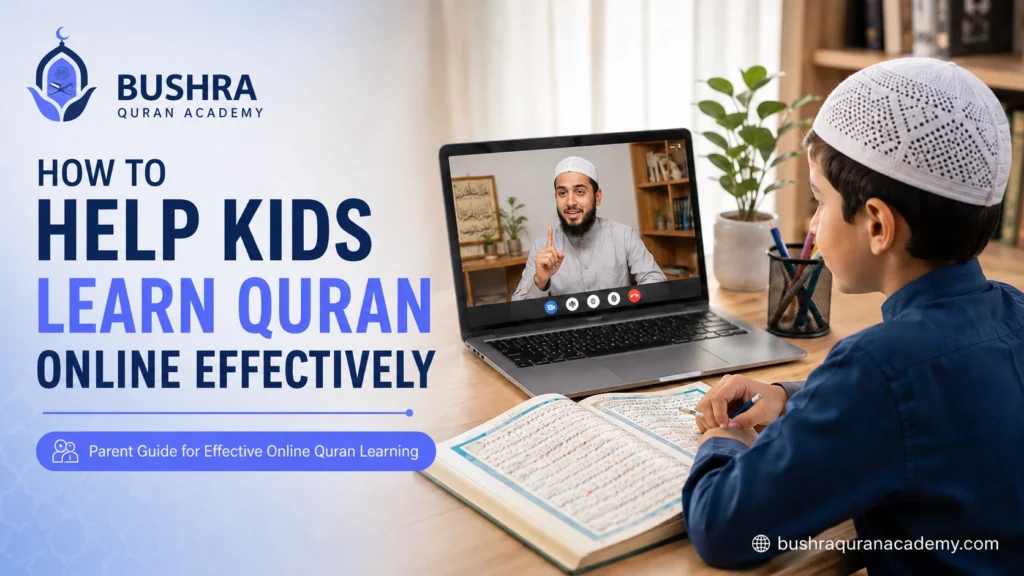
Clear goals help you choose the right course.
If your child cannot read Arabic, do not start with advanced Tajweed or Hifz. Start with the basics.
For most beginners, Noorani Qaida is the best first step because it teaches Arabic letters, sounds, joining letters, and basic Quran reading.
Parents who want flexible Quran learning options can also explore online Quran classes for kids for structured lessons with qualified teachers.
2. Choose a Qualified Quran Teacher for Kids
The teacher is the most important part of online Quran learning.
A good Quran teacher for kids should not only know Tajweed. The teacher should also know how to teach children with patience and kindness.
Look for a teacher who has:
- Strong Quran recitation
- Good Tajweed knowledge
- Experience teaching children
- Clear communication
- Patience with mistakes
- A soft and respectful teaching style
- Regular progress feedback
- Punctual class timing
Children learn better when they feel safe, respected, and encouraged.
A strict or boring teacher may make the child dislike Quran class. A kind and skilled teacher can help the child build confidence and love for the Quran.
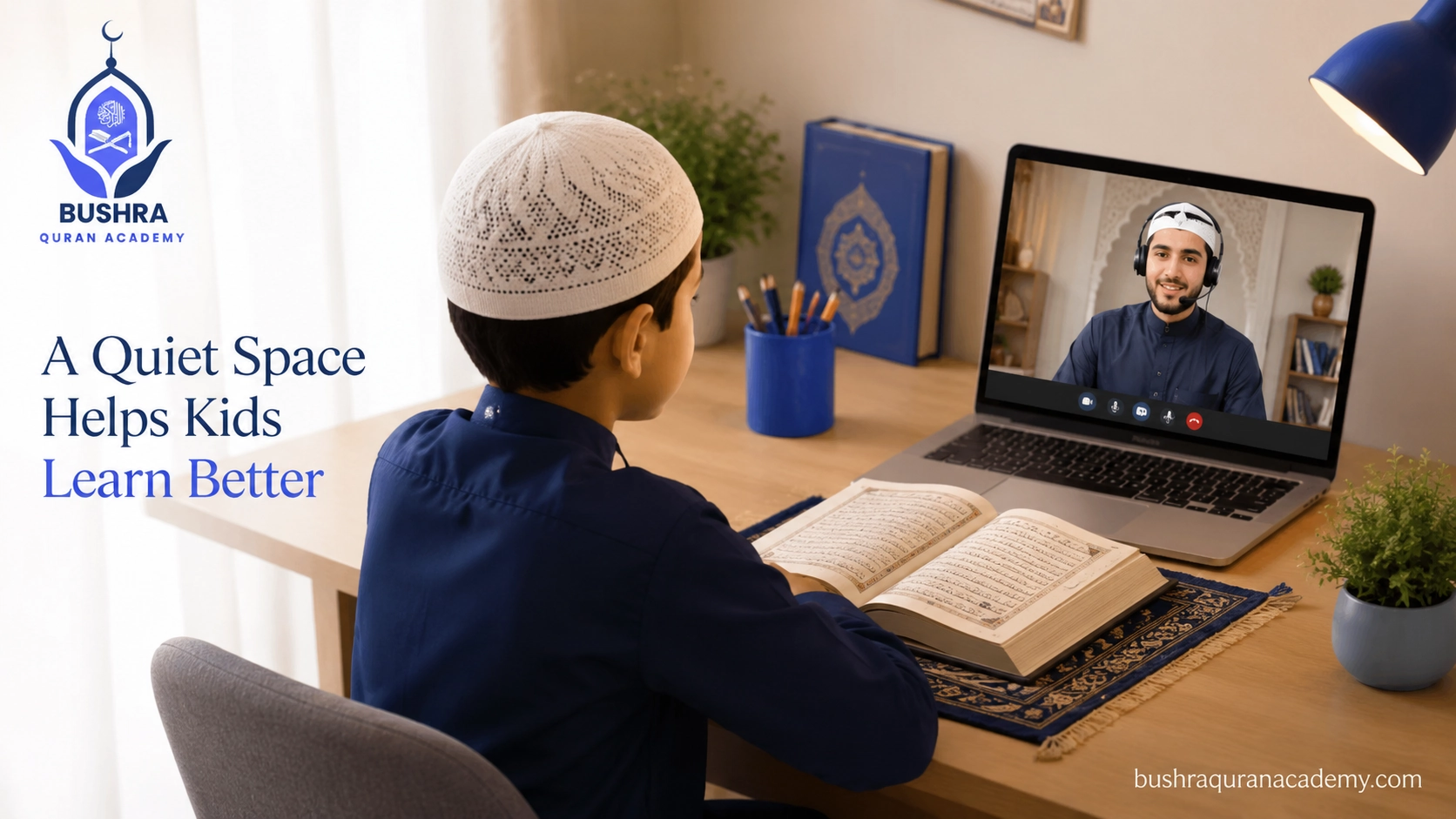
3. Create a Quiet Quran Learning Space at Home
Your child needs a proper place for online Quran class.
It does not need to be a full study room. A small clean corner is enough.
The place should be away from:
- TV noise
- Mobile games
- Toys
- Loud conversations
- Siblings disturbing the class
- Food and unnecessary items
Keep these things ready before class:
- Laptop, tablet, or phone
- Stable internet
- Working microphone
- Headphones if needed
- Quran or Qaida book
- Notebook
- Pencil
- Water bottle
When the same space is used every day, the child becomes mentally ready for learning.
This simple setup improves focus and discipline.
4. Keep Lessons Short and Regular
Children do not need very long Quran classes.
Short and consistent lessons are better than long and irregular lessons.
For most kids, 20 to 30 minutes per class is enough.
A good routine can be:
- 3 to 5 classes per week
- 20 to 30 minutes per class
- 5 to 10 minutes daily revision
- Weekly progress check
- One light revision day
Do not force too much in one sitting.
Children learn Quran better when lessons feel manageable.
Consistency is more important than speed.
5. Follow an Age-Wise Quran Learning Path
Every age needs a different teaching style.
A 5-year-old child and a 12-year-old child should not be taught in the same way.
Ages 4 to 6: Early Foundation
At this age, keep learning simple and gentle.
Focus on:
- Arabic letters
- Listening to short Surahs
- Repeating small words
- Basic duas
- Love and respect for the Quran
- Short class duration
Do not overload the child with difficult Tajweed terms.
Ages 7 to 10: Reading and Tajweed Basics
This is a strong age for structured Quran learning.
Focus on:
- Noorani Qaida
- Joining letters
- Quran reading
- Basic Tajweed rules
- Short Surah memorization
- Daily revision
- Correct pronunciation
At this stage, the child can build a strong reading foundation.
Ages 11 to 15: Fluency, Hifz, and Understanding
Older children can handle more structure.
Focus on:
- Fluent Quran recitation
- Strong Tajweed correction
- Hifz plan
- Quran translation basics
- Islamic studies
- Personal responsibility
- Regular progress goals
Teenagers need respect and motivation. Do not treat them like very young children.
6. Make Tajweed a Priority From the Start
Tajweed should not be delayed for too long.
Many children learn to read Quran but continue making pronunciation mistakes because they were not corrected early.
Tajweed helps children pronounce Arabic letters correctly.
This is especially important for letters like:
- ق
- غ
- ع
- ح
- ص
- ض
- ط
- ظ
A qualified Quran teacher can listen carefully and correct mistakes during live recitation.
Parents should not rush children to finish Qaida or Quran quickly.
Correct recitation is better than fast recitation.
7. Revise for 5 to 10 Minutes Daily
Online Quran classes are not enough without revision.
Children forget quickly if they do not repeat lessons.
Parents do not need to be Quran experts to help with revision. You only need to keep the routine.
After class, ask your child:
- What did you learn today?
- Which part was difficult?
- What did the teacher ask you to revise?
- Can you read today’s lesson once?
- What will you practice tomorrow?
A simple daily revision plan:
- Monday to Thursday: revise the same day’s lesson
- Friday: revise all weekly lessons
- Saturday: listen to short Surahs
- Sunday: light review or rest
Even 5 minutes a day can make a big difference.
8. Use Positive Motivation and Small Rewards
Children need encouragement.
Many kids start Quran classes with excitement but lose interest after some time. This is normal.
Do not make Quran learning feel like punishment.
Use small rewards for small achievements.
Reward your child when they:
- Complete a Qaida page
- Learn a difficult letter
- Read without mistakes
- Memorize a short Surah
- Attend classes regularly for a week
- Improve Tajweed
- Show good manners during class
Rewards can be simple:
- Praise
- Stickers
- Extra playtime
- A small treat
- Choosing a family activity
- A progress chart
The goal is to make the child feel proud of learning the Quran.
9. Stay Involved as a Parent
Parents should not disappear after enrollment.
Online Quran learning works best when parents stay connected with the teacher.
Ask the teacher:
- Is my child attending on time?
- Is my child improving?
- Which mistakes are repeated?
- What should we revise at home?
- Is the class length suitable?
- Is my child focused or distracted?
- Should we change the learning goal?
This keeps the child accountable.
It also helps parents fix small problems before they become big problems.
10. Keep Online Quran Classes Safe
Safety is very important in online learning.
Parents should supervise the learning environment, especially for young children.
Follow these rules:
- Use the parent’s email or contact number for class communication
- Do not allow private teacher-child messaging
- Keep the class device in a visible area
- Check who is teaching your child
- Prefer academies with teacher screening
- Ask for parent updates
- Monitor class behavior
- Keep payment and account access with parents
A good online Quran academy should respect child safety and parent involvement.
Parents should know who is teaching their child, how classes are conducted, and how progress is tracked.
11. Reduce Screen Fatigue
Online Quran learning uses screens, so parents should manage screen tiredness.
Keep classes short and avoid scheduling Quran class right after long gaming or video time.
Helpful tips:
- Use good lighting
- Keep the screen at eye level
- Adjust brightness
- Use headphones only if needed
- Give a short break before class
- Avoid very late class timings
- Let the child rest after school
You can also use the 20-20-20 rule.
After 20 minutes of screen time, ask your child to look at something 20 feet away for 20 seconds.
This helps reduce eye strain and refresh focus.
12. Choose One-on-One or Group Classes Wisely
Both one-on-one and group classes can work.
The right choice depends on your child.
One-on-One Quran Classes Are Better For:
- Young children
- Beginners
- Shy students
- Tajweed correction
- Noorani Qaida
- Hifz students
- Children who need full attention
Group Quran Classes Are Better For:
- Social learners
- Older children
- Revision sessions
- Islamic studies discussions
- Children motivated by classmates
For most beginners, one-on-one online Quran classes are usually better because the teacher can focus fully on the child’s mistakes and progress.
13. Build Love for the Quran at Home
The goal is not only to complete lessons.
The real goal is to help children build a lifelong connection with the Quran.
Parents can help by making the Quran part of family life.
Try this:
- Recite short Surahs at home
- Listen to Quran recitation together
- Tell simple Quran stories
- Explain short meanings in easy words
- Praise effort, not only results
- Make dua for your child
- Show respect when handling the Quran
- Let your child see you recite too
Children copy what they see.
When parents respect the Quran, children learn to respect it too.
Common Problems and Simple Solutions
My child gets distracted during online Quran class.
Choose a quiet place, remove toys and mobile distractions, and keep lessons short. Also ask the teacher to use a more interactive teaching style.
My child forgets lessons quickly.
Add 5 to 10 minutes of daily revision. Repetition is necessary for Noorani Qaida, Tajweed, and memorization.
My child feels tired after school.
Change the class time. Some children learn better after Maghrib, while others learn better before dinner or on weekends.
My child is shy with the Quran teacher.
Start with short one-on-one classes. Give the teacher time to build trust with your child.
My child does not like Quran class.
Do not force harshly. Check the teacher’s style, class timing, lesson difficulty, and your child’s energy level. Sometimes a small change fixes the problem.
My internet disconnects during class.
Keep a backup internet option if possible. Inform the teacher quickly and request a short makeup session if needed.
Parent Checklist Before Choosing an Online Quran Academy
Before enrolling your child, check these points:
- Does the academy offer a free trial class?
- Are teachers qualified in Quran and Tajweed?
- Do teachers have experience with children?
- Are male and female teachers available?
- Is there a beginner course like Noorani Qaida?
- Are classes one-on-one or group-based?
- Are timings flexible for your country?
- Does the academy provide progress updates?
- Is parent communication clear?
- Is child safety taken seriously?
- Are prices clear?
- Can the course match your child’s level?
Do not choose an academy only because it is cheap.
Choose the academy that gives your child quality, safety, structure, and consistency.
Best Way to Help Kids Learn Quran Online
The best way to help kids learn Quran online is to combine four things:
- A qualified Quran teacher
- A clear learning goal
- A short and consistent routine
- Parent support at home
Online Quran learning becomes effective when the child knows what to learn, the teacher knows how to teach, and the parent keeps the routine strong.
Final Thoughts
Helping kids learn Quran online effectively requires more than just signing up for classes.
Parents should set clear goals, choose a qualified Quran teacher, create a quiet study space, keep lessons short, revise daily, and stay involved.
Children also need encouragement, patience, and a safe online learning environment.
With the right teacher and parent support, your child can learn Noorani Qaida, improve Tajweed, recite Quran confidently, memorize short Surahs, and build love for the Quran from home.
Bushra Quran Academy offers online Quran classes for kids with qualified teachers, flexible timings, beginner-friendly courses, and one-on-one support.
Parents can start with a free trial class and choose the course that matches their child’s current level.
Frequently Asked Questions About How to Help Kids Learn Quran Online Effectively
How can I help my child learn Quran online effectively?
Are online Quran classes effective for kids?
What should kids learn first in online Quran classes?
How many Quran classes per week are best for children?
What age can kids start learning Quran online?
Are one-on-one Quran classes better for kids?
More To Explore


Register Now For Online Quran
Courses
Contact us for any questions or queries, and fill out the form below to request a free trial.
We are available 24/7 for support and services
