
When is Qurbani 2026? The Essential Guide to Sacred Dates, Rules, and Traditions
The arrival of the final month of the Islamic lunar calendar brings a profound period of reflection, devotion, and community solidarity. For millions of Muslims globally, calculating the exact timing of the sacred sacrifice is a critical annual task. Proper coordination guarantees compliance with prophetic traditions and ensures timely distribution of meat to vulnerable populations.
Navigating shifting lunar calendars can present logistical challenges for families arranging local slaughters or sending support overseas. At Bushra Quran Academy, we understand that precision matters when fulfilling your spiritual obligations. This resource provides the structural timeline, theological background, and practical rules required to confidently prepare for Qurbani 2026.
Defining the Sacred Sacrifice: What is Qurbani?
To appreciate the temporal requirements of this period, one must first master the terminology and theological foundations.
What is Qurbani?
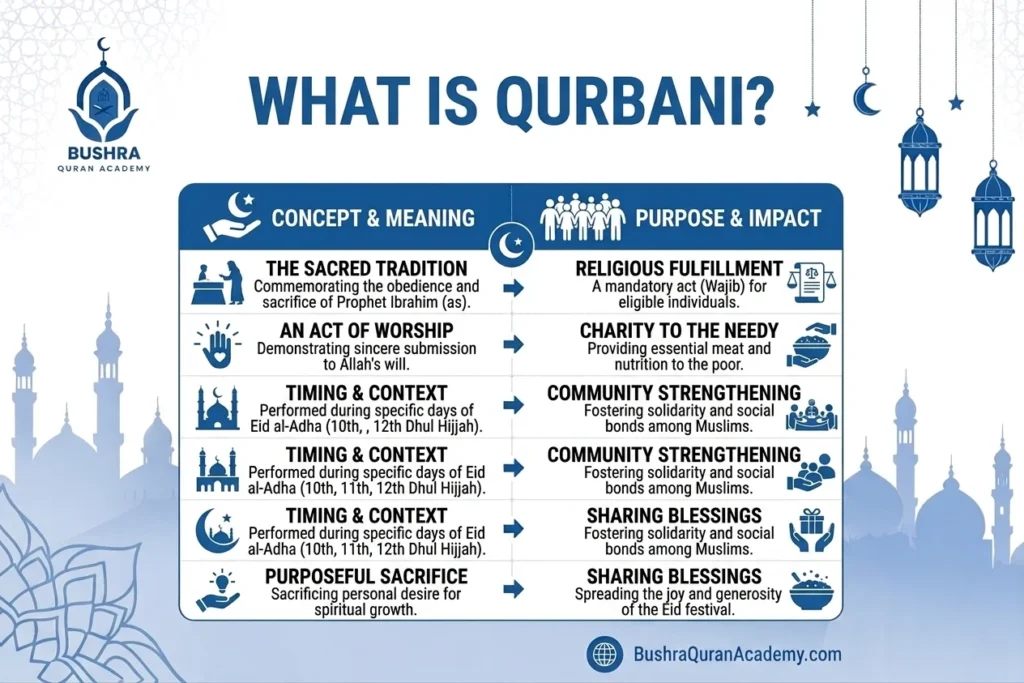
The word Qurbani derives from the Arabic term Qurban, rooted in the concept of seeking nearness or closeness to Allah. It represents the ritual slaughter of a specific livestock animal during the designated days of Eid ul Adha. This act commemorates the profound submission of Prophet Ibrahim (AS), who demonstrated an unwavering willingness to sacrifice his son Ismail (AS) in obedience to a divine command. At the final moment, Allah replaced Ismail (AS) with a ram, establishing a perpetual rite of devotion for future generations.
What is Udhiyah?
In classical Islamic jurisprudence, scholars use the specific term Udhiyah to refer to the legal animal sacrifice offered on the days of Eid ul Adha. While the colloquial term used across South Asia, Central Asia, and the West is often Qurbani, legal texts use Udhiyah to describe the technical rulings, conditions, and standards governing the valid selection and slaughter of the animal.
Key Islamic Calendar Milestones: When is Dhul Hijjah 2026?
The sacred month of When is Dhul Hijjah 2026? began on the evening of Monday, May 18, 2026, following the confirmed sighting of the crescent moon. The first ten days of this month represent a uniquely blessed window. Prophetic narrations emphasize that righteous deeds performed during
The Day of Arafah 2026 Date
The spiritual peak of the Hajj pilgrimage occurs on the 9th day of the month. The day of arafah 2026 falls on Tuesday, May 26, 2026. For those not participating in the pilgrimage, fasting on this day serves as an established Sunnah that expiates the sins of the preceding and succeeding years.
Exact Dates for Eid al Adha 2026 and Qurbani Execution
The performance of the sacrifice is strictly bound by time. It cannot occur before the Eid prayer concludes, and it must end before the sun sets on the final designated day.
When is Eid 2026?
The global celebration of eid al adha 2026 begins on the 10th day of the sacred month. In regions following the global lunar sightings, including Saudi Arabia and many Western communities, the 2026 eid ul adha date corresponds to Wednesday, May 27, 2026. In countries tracking localized sightings, such as Pakistan and India, celebrations commence on Wednesday, May 27, 2026.
| Islamic Date (1447 AH) | Occasion | Gregorian Date (Western/Saudi) | Gregorian Date (South Asia/Local Sighting) |
| 1 Dhul Hijjah | Commencement of Holy Month | Monday, May 18, 2026 | Tuesday, May 19, 2026 |
| 9 Dhul Hijjah | day of arafah 2026 | Tuesday, May 26, 2026 | Wednesday, May 27, 2026 |
| 10 Dhul Hijjah | eid al adha 2026 (Day 1) | Wednesday, May 27, 2026 | Thursday, May 28, 2026 |
| 11 Dhul Hijjah | Days of Tashreeq (Day 2) | Thursday, May 28, 2026 | Friday, May 29, 2026 |
| 12 Dhul Hijjah | Days of Tashreeq (Day 3) | Friday, May 29, 2026 | Saturday, May 30, 2026 |
| 13 Dhul Hijjah | Final Window for Sacrifice | Saturday, May 30, 2026 | Sunday, May 31, 2026 |
The Legal Time Window for Slaughter
A sacrifice performed even moments before the conclusion of the local Eid prayer defaults to a standard donation of meat, requiring a replacement slaughter to fulfill the specific obligation. The valid window opens immediately following the Eid prayer on the 10th of the month.
According to the Hanafi school of thought, the permissible window spans three distinct days, concluding at sunset on the 12th of the month. The Shafi’i, Maliki, and Hanbali schools extend this period across four days, allowing slaughters until the sunset of the 13th day. Working within the primary three-day window ensures universal validity across all major schools of jurisprudence.
Accountability and Eligibility: Who is Eligible for Qurbani?
Determining financial accountability requires assessing individual wealth against established legal benchmarks.
Criteria for Eligibility
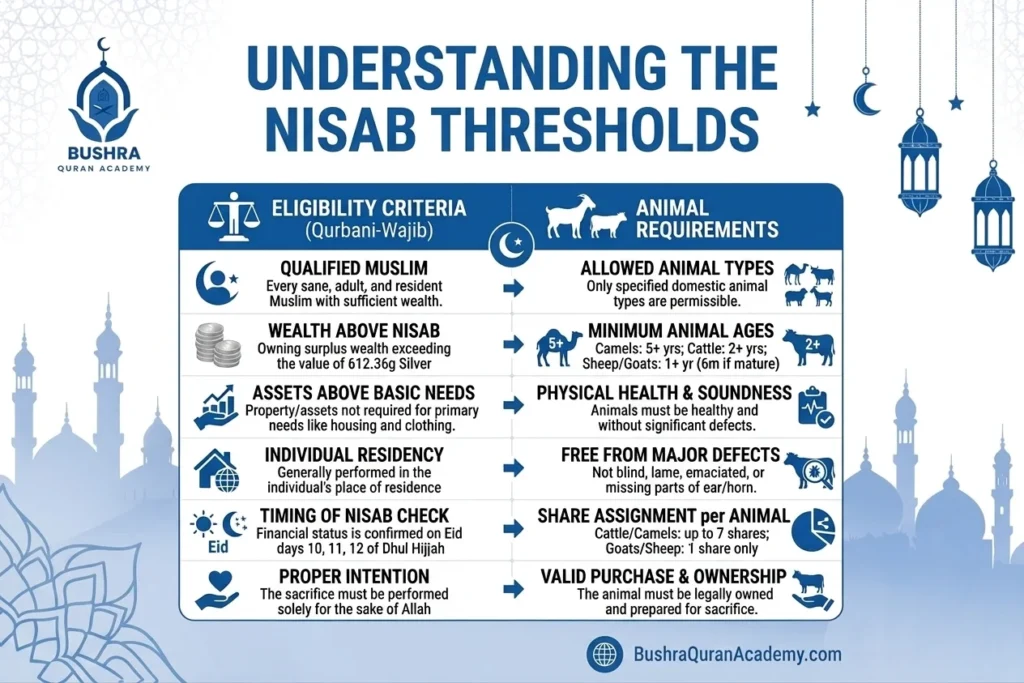
The obligation applies to every sane, adult Muslim who possesses wealth exceeding a specific threshold, known as the Nisab, on the days of Eid. Unlike the calculation for Zakat, which requires holding assets for a full uninterrupted year, eligibility for this sacrifice depends solely on wealth held during the specific days of celebration.
Understanding the Nisab Thresholds
The financial benchmark relies on the historical values of precious metals:
Gold Benchmark: The equivalent value of 87.48 grams of pure gold.
Silver Benchmark: The equivalent value of 612.36 grams of pure silver.
In contemporary practice, humanitarian organizations and academic institutions evaluate contemporary asset values against the silver benchmark to expand participation and increase aid delivery to global beneficiaries. If your net liquid assets—including cash, surplus inventory, and disposable wealth beyond your immediate basic needs—exceed this silver monetary value on the mornings of Eid, performing the sacrifice becomes an active requirement.
Expert Tips for a Valid Sacrifice
The Hair and Nail Rule: If you intend to offer a sacrifice, it is a highly recommended prophetic practice to abstain from cutting your hair or trimming your nails from the first day of Dhul Hijjah until your animal is successfully slaughtered.
Animal Quality Verification: The selected livestock must meet strict physical integrity checks. Animals displaying clear blindness, severe emaciation, missing limbs, or structural broken horns that damage health are legally invalid for sacrifice.
Age Requirements: Sheep and goats must be at least one full year old. Cattle must reach a minimum of two years of age, and camels must reach five years of age.
Operational Execution: Step-by-Step Strategic Framework
Managing the logistics of a physical sacrifice demands attention to safety, hygiene, and ethical guidelines. Follow this structured protocol to manage your obligations efficiently:
Select a reputable local farmer or an international humanitarian platform. If utilizing a global proxy donation, verify that their field teams operate within your intended time zone to prevent premature slaughters.
Inspect the animal thoroughly. Ensure it meets the absolute minimum age restrictions and displays clear signs of vitality, free from visible injuries, limping, or wasting illness.
Ensure the implement is sharpened completely away from the animal’s view to eliminate distress. Lay the animal gently on its left side facing the Qiblah, pronounce the divine name (Bismillahi Allahu Akbar), and make a swift, continuous cut through the jugular veins, carotid arteries, trachea, and esophagus.
Divide the clean meat yield into three precise, equal portions: one-third for your immediate household, one-third for distribution to relatives and neighbors, and one-third dedicated to impoverished families.
Conclusion: Preparing Your Intentions
Fulfilling your obligations for Qurbani 2026 requires a balance of correct timing, clear eligibility checks, and adherence to legal rules. By organizing your preferences ahead of the 2026 eid ul adha date, you avoid last-minute stress and ensure your resources reach those in need effectively.
Frequently Asked Questions About Qurbani 2026
When is Eid 2026?
What happens if I miss the deadline?
Is Qurbani mandatory for children?
Who is eligible and financially accountable to perform Qurbani?
How should the meat yield from the Qurbani be distributed?
More To Explore
12 Rabi ul Awal 2026: When Is 12 Rabi ul Awal 2026?
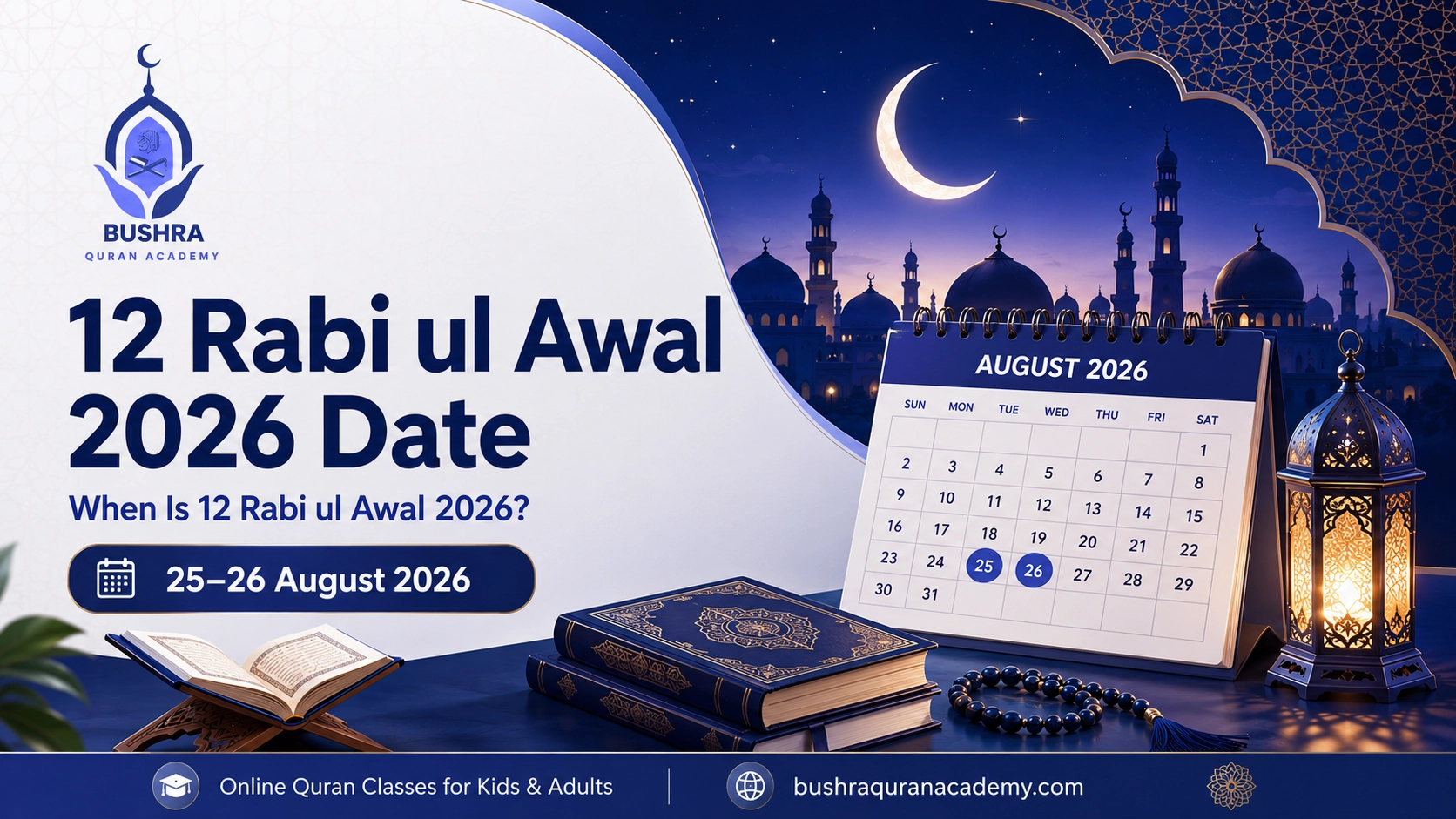
When is 12 Rabi ul Awal 2026? Pakistan will observe 12 Rabi ul Awal 1448 AH on Wednesday, 26 August 2026, following its official moon-sighting decision. Other countries and Islamic calendars may observe it on 25 or 26 August depending on their calendar method.
Best Muslim Baby Boy Names 2026: Quranic, Modern & Meaningful
Discover beautiful Muslim baby boy names for 2026, including Quranic, modern, rare, Arabic, and meaningful Islamic names.

How to Help Kids Learn Quran Online Effectively
Learn simple ways to help kids learn Quran online with clear goals, a quiet study space, qualified teachers, and regular practice.
Register Now For Online Quran
Courses
Contact us for any questions or queries, and fill out the form below to request a free trial.
We are available 24/7 for support and services
