

How to Memorize Quran for Beginners: Easy 30-Day Hifz Plan

Learning how to memorize Quran for beginners can feel difficult at first. A student may not know where to begin, how many verses to memorize daily, or what to do when previously learned verses are forgotten.
Beginners do not need an unusually strong memory or many hours of free time. A successful Hifz journey normally begins with correct Quran reading, a small daily target, structured repetition, regular revision, and guidance from a patient teacher.
This guide explains how children and adults can begin Quran memorization step by step. It also includes a practical 30-day plan for Muslim families in the USA, UK, Canada, and other countries.
Quick Answer: The best way to understand how to memorize Quran for beginners is to begin with a short passage, listen to an accurate recitation, read the verse correctly, repeat it several times, recite it without looking, and revise it every day. Accuracy and retention are more important than speed.
Table of Contents
How to Memorize Quran for Beginners: What to Know First
Before starting a daily memorization target, the learner should check whether their basic Quran reading foundation is ready.
A student does not need perfect Tajweed before memorizing the first short Surah. However, the selected verses must be read and pronounced correctly.
Beginner Hifz Readiness Checklist
A learner may be ready to start Quran memorization when they can:
- Recognize Arabic letters and vowel signs.
- Read short Quranic words with reasonable confidence.
- Repeat a verse after listening to a teacher.
- Focus for at least 15 to 30 minutes.
- Follow a simple daily routine.
- Accept correction without becoming discouraged.
- Revise previously learned verses regularly.
A learner who still struggles with Arabic letters, joining sounds, or basic pronunciation should begin with Noorani Qaida before attempting a larger Hifz target.
How to Memorize Quran for Beginners Step by Step
The following method gives beginners a simple system that can be repeated every day.
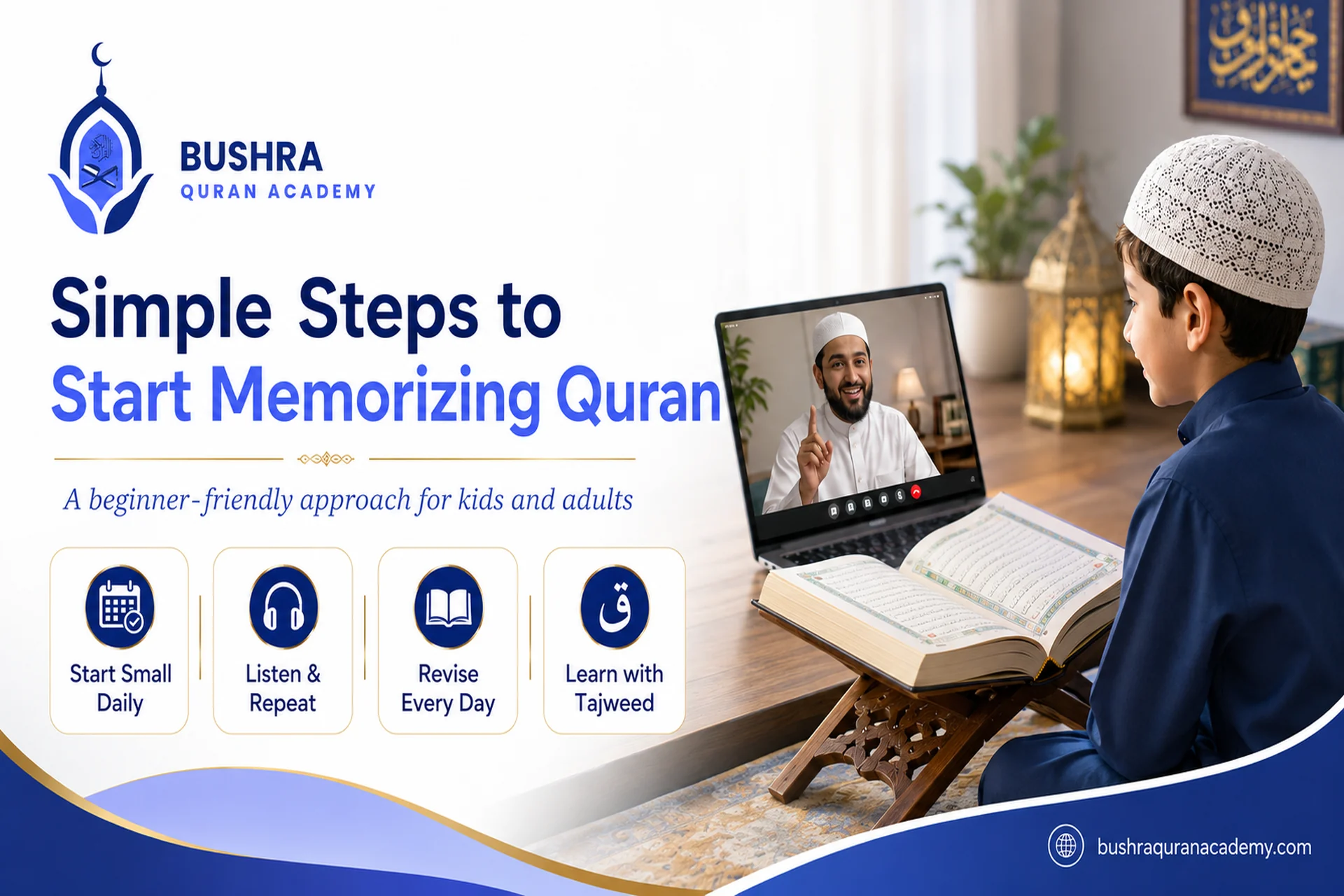
Step 1: Begin With a Sincere Intention
Quran memorization should begin with the intention of seeking Allah’s pleasure and building a lifelong connection with His Book.
A sincere intention helps learners continue when progress becomes slow.
Parents should remind children that:
- Small progress is still valuable.
- Mistakes are part of learning.
- Revision is as important as new memorization.
- Every learner progresses at a different pace.
- Hifz should not become a competition.
Step 2: Read the Verse Correctly First
Never begin memorizing a verse that the learner cannot read correctly.
Before memorization:
- Listen to the verse from a qualified teacher or clear reciter.
- Identify difficult words.
- Correct the pronunciation of individual letters.
- Notice where to stop.
- Read the complete verse slowly.
- Repeat the verse while looking at the Mushaf.
This prevents the student from memorizing pronunciation mistakes.
Step 3: Use the Same Mushaf
Using the same Quran copy can help the learner remember where verses appear on the page.
Avoid changing between different page layouts during the early stages of Hifz.
Keep the Mushaf in the same learning area and use it for both new memorization and revision.
Step 4: Start With a Small Portion
A common beginner mistake is trying to memorize too much during the first week.
A beginner can start with:
- One short verse.
- One to three lines.
- A small part of a longer verse.
- A short Surah from Juz Amma.
The correct daily target is not the amount a learner can repeat once. It is the amount they can recite correctly the next day.
Step 5: Use the Listen, Look, Recite and Connect Method
This four-part method works well for beginners.
- Listen: Hear the complete verse carefully two or three times.
- Look: Read the verse while following each word in the Mushaf.
- Recite: Cover the verse and recite it from memory.
- Connect: Join the new verse with the verse before it.
When a mistake occurs, return to the Mushaf instead of guessing.
Correct the mistake and then repeat the complete phrase again.
Step 6: Break Long Verses Into Short Parts
A long verse does not need to be memorized in one attempt.
Use this method:
- Memorize the first phrase.
- Memorize the second phrase separately.
- Join both phrases.
- Add the next phrase.
- Recite the complete verse.
- Repeat the verse without looking.
Breaking verses into smaller parts reduces mental pressure.
Step 7: Revise Before Learning Something New
Revision should happen before the new lesson.
A useful daily order is:
- Old memorization.
- Recently memorized verses.
- Yesterday’s lesson.
- Today’s new lesson.
Students needing a complete Hifz structure can explore Bushra Quran Academy’s Quran memorization course, which combines new lessons with teacher correction and revision.
How Much Quran Should a Beginner Memorize Daily?
There is no single daily target suitable for everyone.
The amount depends on:
- Age.
- Quran reading ability.
- Tajweed level.
- School or work schedule.
- Memory strength.
- Available revision time.
- Teacher recommendation.
Suggested starting targets:
- Young children: one short verse or one to two lines.
- Older children: two to five lines.
- Teenagers: three to seven lines.
- Adult beginners: two to five lines.
These are only starting suggestions.
Someone learning how to memorize Quran for beginners should remember that a small portion memorized correctly is better than a large portion forgotten after a few days.
First 30 Days Quran Memorization Plan
A 30-day routine gives beginners enough time to build consistency without rushing.
Days 1 to 7: Build the Routine
uring the first week, focus on creating a habit.
- Select one daily memorization time.
- Choose a quiet Quran learning space.
- Use the same Mushaf.
- Start with a very small portion.
- Listen before memorizing.
- Revise the lesson again later in the day.
- Record mistakes in a notebook.
The purpose of the first week is consistency, not quantity.
Days 8 to 14: Improve Repetition
During the second week, use the same memorization method every day.
- Listen carefully.
- Read the verse correctly.
- Repeat it in small phrases.
- Recite without looking.
- Connect verses together.
- Revise everything memorized during the first week.
At this stage, the learner should begin identifying recurring mistakes.
Days 15 to 21: Strengthen Retention
During the third week, earlier lessons may start becoming weak.
Do not keep increasing the new lesson while old verses are being forgotten.
Instead:
- Reduce the new portion.
- Increase revision time.
- Recite older verses to a teacher.
- Review difficult connections.
- Take one revision-only day if needed.
The most important part of learning how to memorize Quran for beginners is protecting previous lessons.
Days 22 to 30: Review the First Month
At the end of the month, recite the complete memorized portion to a teacher or capable listener.
Review:
- Pronunciation.
- Missing words.
- Verse connections.
- Tajweed mistakes.
- Stopping points.
- Confidence without looking.
- Daily consistency.
The second-month target should be based on this review.
Should Beginners Learn Tajweed Before Hifz?
Beginners do not need to master every advanced Tajweed rule before memorizing short Surahs.
However, they should pronounce the selected verses correctly.
Tajweed is especially important for:
- Makharij.
- Heavy and light letters.
- Long and short sounds.
- Ghunnah.
- Correct stopping.
- Similar-sounding Arabic letters.
- Joining words correctly.
Students who repeatedly struggle with pronunciation should combine memorization with Tajweed e Quran classes.
Correcting pronunciation before memorization is easier than correcting several pages of memorized mistakes later.
How Families in USA, UK and Canada Can Build a Hifz Routine
Muslim families in Western countries often balance Quran learning with school, homework, work schedules, sports, extracurricular activities, and travel.
Online classes allow families to build a Hifz schedule around their actual routine.
Quran Memorization in the USA
Parents in the USA should choose a class time based on their actual time zone:
- Eastern Time.
- Central Time.
- Mountain Time.
- Pacific Time.
Avoid choosing a class time that clashes with school homework, dinner, or bedtime.
Parents can also review our guide to the best online Quran classes for kids in USA.
Not Sure Whether You or Your Child Is Ready for Hifz?
Begin with a live assessment and trial lesson. A teacher can check Quran reading, pronunciation, Tajweed, attention level, and a suitable beginner memorization target.
Request a 3-Day Free Hifz TrialQuran Memorization in the UK
A practical UK routine may include:
- Short lesson after school and rest.
- Revision after Maghrib.
- Listening practice before sleep.
- Longer review during the weekend.
Quran Memorization in Canada
Online Hifz can be especially useful for Canadian families dealing with:
- Long travel distances.
- Different time zones.
- Severe winter weather.
- Limited nearby Quran teachers.
- Busy school schedules.
Practical School-Day Routine
A simple routine may look like this:
- Before school: 10 minutes of old revision.
- After school and rest: 20 to 30-minute teacher lesson.
- After Maghrib or Isha: repeat the new lesson.
- Before sleep: listen to the next passage.
- Weekend: complete a longer weekly review.
When Should a Child Join Structured Hifz Classes?
A child may benefit from structured teaching when they can:
- Read basic Quran.
- Repeat verses accurately.
- Follow a short routine.
- Revise with parent support.
- Remain focused during a lesson.
- Accept teacher correction.
Structured Hifz classes for kids can provide teacher accountability, Tajweed correction, organized revision, progress evaluation, and a suitable daily lesson target.
Parents should not select a program only because it promises fast completion.
Frequently Asked Questions
How can a beginner start memorizing Quran?
How many Ayahs should a beginner memorize daily?
Should I learn Tajweed before memorizing Quran?
Can I memorize Quran without a teacher?
How to memorize Quran for beginners without forgetting?
Ready to Build a Consistent Hifz Routine?
Speak with our Quran learning team about your goals, current reading level, preferred class time, and the right memorization plan for you or your child.
Discuss Your Hifz GoalsMore To Explore




Register Now For Online Quran
Courses
Contact us for any questions or queries, and fill out the form below to request a free trial.
We are available 24/7 for support and services
