
3rd Kalma (Kalma Tamjeed): Arabic, Meaning in English and Urdu
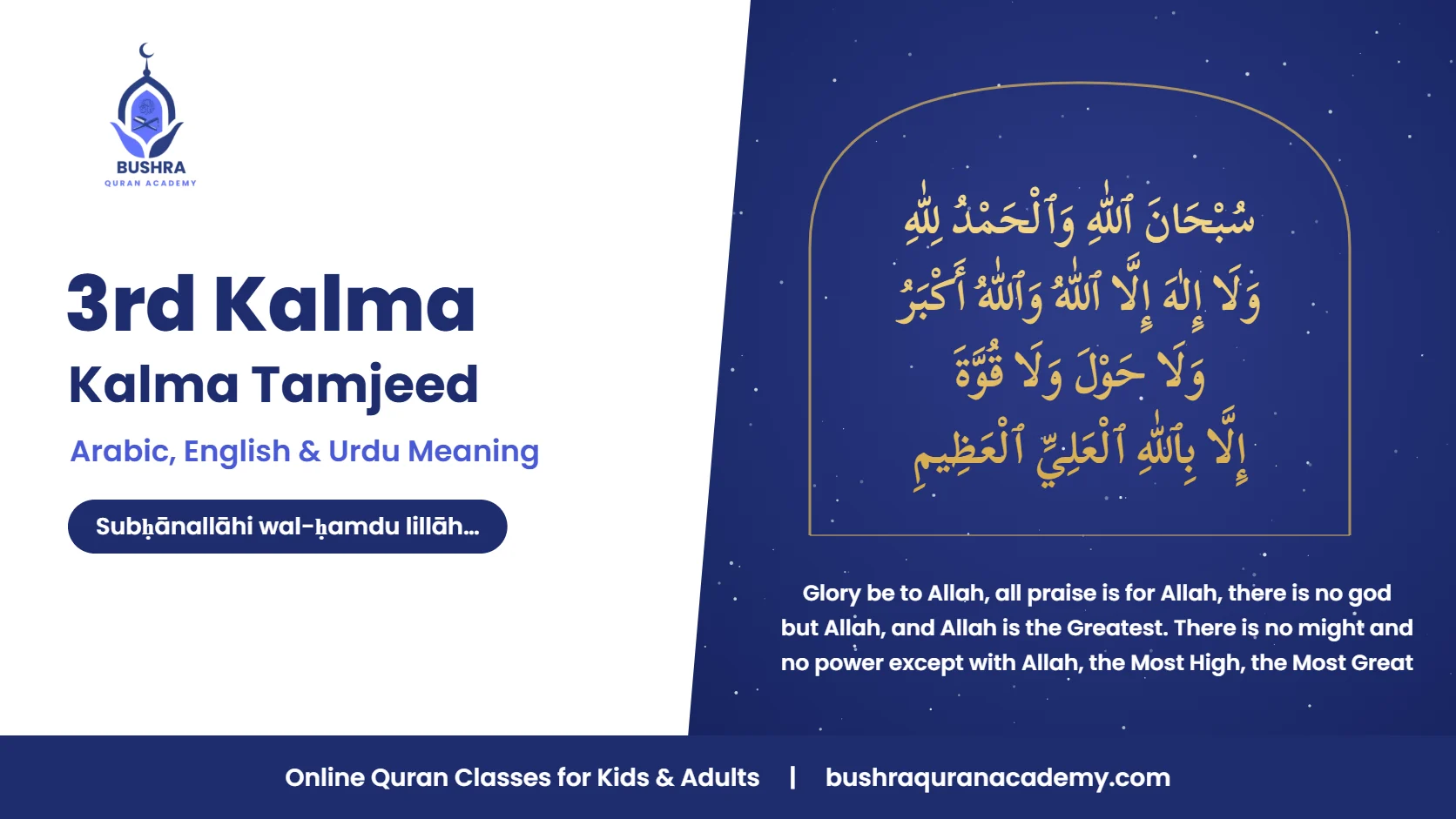
The 3rd Kalma, also called Kalma Tamjeed (“the word of glorification”), is سُبْحَانَ ٱللّٰهِ وَٱلْحَمْدُ لِلّٰهِ وَلَا إِلٰهَ إِلَّا ٱللّٰهُ وَٱللّٰهُ أَكْبَرُ وَلَا حَوْلَ وَلَا قُوَّةَ إِلَّا بِٱللّٰهِ ٱلْعَلِيِّ ٱلْعَظِيمِ, Subḥānallāhi wal-ḥamdu lillāhi wa lā ilāha illallāhu wallāhu akbar, wa lā ḥawla wa lā quwwata illā billāhil-ʿaliyyil-ʿaẓīm. It means “Glory be to Allah, all praise is for Allah, there is no god but Allah, and Allah is the Greatest. There is no might and no power except with Allah, the Most High, the Most Great.”
It joins five short phrases that the Prophet ﷺ praised again and again: Subḥānallāh, al-ḥamdu lillāh, lā ilāha illallāh, Allāhu akbar and lā ḥawla wa lā quwwata illā billāh. The first four are “the dearest words to Allah” (Sahih Muslim 2137), and the last is “a treasure from the treasures of Paradise” (Sahih al-Bukhari 6384). Below you will find the 3rd Kalma in Arabic, English, Urdu and Hindi, a word-by-word meaning, the hadith behind each phrase, pronunciation tips and how to teach it to children. See also the 1st Kalma, the 2nd Kalma and all 6 Kalimas.
Table of Contents
3rd Kalma at a Glance
| Name | 3rd Kalma, Kalma Tamjeed (Kalimat at-Tamjīd, “the word of glorification”), Teesra Kalma |
|---|---|
| Arabic | سُبْحَانَ ٱللّٰهِ وَٱلْحَمْدُ لِلّٰهِ وَلَا إِلٰهَ إِلَّا ٱللّٰهُ وَٱللّٰهُ أَكْبَرُ وَلَا حَوْلَ وَلَا قُوَّةَ إِلَّا بِٱللّٰهِ ٱلْعَلِيِّ ٱلْعَظِيمِ |
| Transliteration | Subḥānallāhi wal-ḥamdu lillāhi wa lā ilāha illallāhu wallāhu akbar, wa lā ḥawla wa lā quwwata illā billāhil-ʿaliyyil-ʿaẓīm |
| English meaning | Glory be to Allah, all praise is for Allah, there is no god but Allah, and Allah is the Greatest. There is no might and no power except with Allah, the Most High, the Most Great. |
| Number of Arabic words | 18 (as written) |
| What it contains | Tasbīḥ (Subḥānallāh), Taḥmīd (al-ḥamdu lillāh), Tahlīl (lā ilāha illallāh), Takbīr (Allāhu akbar) and Ḥawqalah (lā ḥawla wa lā quwwata illā billāh) |
| Source of the wording | The phrases are in authentic hadith (Sahih Muslim 2137 and 2695, Sahih al-Bukhari 1154 and 6384); the full wording with “al-ʿAliyy al-ʿAẓīm” is reported from ʿUthman ibn ʿAffan (Musnad Ahmad, cited by Ibn Kathir on 18:46) |
3rd Kalma in Arabic, English, Urdu and Hindi
| Language | 3rd Kalma |
|---|---|
| Arabic | سُبْحَانَ ٱللّٰهِ وَٱلْحَمْدُ لِلّٰهِ وَلَا إِلٰهَ إِلَّا ٱللّٰهُ وَٱللّٰهُ أَكْبَرُ وَلَا حَوْلَ وَلَا قُوَّةَ إِلَّا بِٱللّٰهِ ٱلْعَلِيِّ ٱلْعَظِيمِ |
| Transliteration | Subḥānallāhi wal-ḥamdu lillāhi wa lā ilāha illallāhu wallāhu akbar, wa lā ḥawla wa lā quwwata illā billāhil-ʿaliyyil-ʿaẓīm |
| English | Glory be to Allah, all praise is for Allah, there is no god but Allah, and Allah is the Greatest. There is no might and no power except with Allah, the Most High, the Most Great. |
| Urdu | اللہ پاک ہے، اور سب تعریفیں اللہ ہی کے لیے ہیں، اور اللہ کے سوا کوئی معبود نہیں، اور اللہ سب سے بڑا ہے۔ اور نہ کوئی طاقت ہے نہ کوئی قوت، مگر اللہ کی مدد سے جو بلند و برتر اور عظمت والا ہے۔ |
| Hindi | सुब्हानल्लाहि वल्हम्दु लिल्लाहि व ला इलाहा इल्लल्लाहु वल्लाहु अकबर, व ला हौला व ला क़ुव्वता इल्ला बिल्लाहिल अलिय्यिल अज़ीम: अल्लाह पाक है, सब तारीफ़ अल्लाह के लिए है, अल्लाह के सिवा कोई इबादत के लायक़ नहीं, और अल्लाह सबसे बड़ा है। कोई ताक़त और कोई क़ुव्वत नहीं मगर अल्लाह की मदद से, जो सबसे बुलंद और अज़मत वाला है। |
Word-by-Word Meaning of the 3rd Kalma
| Arabic | Transliteration | Meaning |
|---|---|---|
| سُبْحَانَ ٱللّٰهِ | Subḥānallāh | Glory be to Allah (He is free of every flaw) |
| وَٱلْحَمْدُ لِلّٰهِ | wal-ḥamdu lillāh | and all praise is for Allah |
| وَلَا إِلٰهَ | wa lā ilāha | and there is no god (nothing worthy of worship) |
| إِلَّا ٱللّٰهُ | illallāh | except Allah |
| وَٱللّٰهُ أَكْبَرُ | wallāhu akbar | and Allah is the Greatest |
| وَلَا حَوْلَ | wa lā ḥawla | and there is no might (no change, no turning) |
| وَلَا قُوَّةَ | wa lā quwwata | and no power |
| إِلَّا بِٱللّٰهِ | illā billāh | except with Allah |
| ٱلْعَلِيِّ | al-ʿAliyy | the Most High |
| ٱلْعَظِيمِ | al-ʿAẓīm | the Most Great |
What Does the 3rd Kalma Mean?
Each of the five phrases says something different about Allah:
- Subḥānallāh (Tasbīḥ): Allah is free of every flaw, need and partner.
- Al-ḥamdu lillāh (Taḥmīd): all praise and thanks belong to Him, in ease and in hardship.
- Lā ilāha illallāh (Tahlīl): nothing deserves worship except Him. This is the heart of the 1st Kalma.
- Allāhu akbar (Takbīr): He is greater than anything we can imagine or fear.
- Lā ḥawla wa lā quwwata illā billāh (Ḥawqalah): we have no ability to change our state, and no strength to do good or avoid wrong, except through Allah. Ending with “al-ʿAliyy al-ʿAẓīm” (the Most High, the Most Great) names two of His attributes that appear together at the end of Ayat al-Kursi (Al-Baqarah 2:255).
So the 3rd Kalma moves from declaring Allah perfect, to praising Him, to worshipping Him alone, to magnifying Him, and ends with relying on Him.
Where Do the Words of the 3rd Kalma Come From?
The numbered list of “six Kalimas” is a teaching tradition, mainly in South Asia, used to help children memorise key phrases. The words of the 3rd Kalma come from the Sunnah:
- The four dearest words: “The dearest phrases to Allah are four: Subḥānallāh, al-ḥamdu lillāh, lā ilāha illallāh and Allāhu akbar. It does not matter which of them you begin with” (Sahih Muslim 2137).
- All five phrases together: the Prophet ﷺ taught that whoever wakes at night and says a dhikr that includes “al-ḥamdu lillāh, wa subḥānallāh, wa lā ilāha illallāh, wallāhu akbar, wa lā ḥawla wa lā quwwata illā billāh”, then asks Allah for forgiveness or makes dua, will be answered (Sahih al-Bukhari 1154).
- For someone who cannot yet learn the Quran: a man said he could not memorise anything of the Quran, and the Prophet ﷺ taught him these same five phrases (Sunan Abi Dawud 832, graded hasan by al-Albani).
- The ending “al-ʿAliyy al-ʿAẓīm”: Ibn Kathir reports that ʿUthman ibn ʿAffan was asked about “the everlasting good deeds” in Al-Kahf 18:46 and replied with these words, ending “lā ḥawla wa lā quwwata illā billāhil-ʿaliyyil-ʿaẓīm” (recorded by Imam Ahmad).
Why Is It Called Kalma Tamjeed?
Tamjīd comes from majd, meaning glory and honour. To make tamjīd is to glorify and exalt Allah. The name fits, because every phrase of this Kalma glorifies Him: declaring Him perfect, praising Him, affirming that only He is worshipped, calling Him the Greatest and admitting that all power is His. In Urdu-speaking homes it is often simply called Teesra Kalma.
Virtues of the 3rd Kalma in Authentic Hadith
- Dearer than everything the sun rises over: the Prophet ﷺ said that saying “Subḥānallāh, wal-ḥamdu lillāh, wa lā ilāha illallāh, wallāhu akbar” is dearer to him than anything over which the sun rises (Sahih Muslim 2695).
- The dearest words to Allah: the same four phrases (Sahih Muslim 2137).
- A treasure of Paradise: “Lā ḥawla wa lā quwwata illā billāh” is “one of the treasures of Paradise” (Sahih al-Bukhari 6384; Sahih Muslim 2704).
- A night dua that is answered: said on waking at night, followed by asking for forgiveness (Sahih al-Bukhari 1154).
- Sins forgiven: “There is no one on earth who says: Lā ilāha illallāh, wallāhu akbar, wa lā ḥawla wa lā quwwata illā billāh, except that his sins are forgiven, even if they are like the foam of the sea” (Jami at-Tirmidhi 3460, graded hasan by Darussalam).
A note on a popular narration: the report that Prophet Ibrahim (peace be upon him) said the plants of Paradise are “Subḥānallāh, al-ḥamdu lillāh, lā ilāha illallāh, Allāhu akbar” is in Jami at-Tirmidhi 3462. At-Tirmidhi called it hasan gharib, and the Darussalam edition grades it weak, so it is best mentioned with that grading.
The Everlasting Good Deeds (Al-Baqiyat as-Salihat)
Allah says: “Wealth and children are the adornment of this worldly life, but the everlasting good deeds are far better with your Lord in reward and in hope” (Al-Kahf 18:46).
Early scholars explained “the everlasting good deeds” (al-bāqiyāt aṣ-ṣāliḥāt) in more than one way. Ibn Kathir reports that Ibn ʿAbbas and others said they are the five daily prayers, and that Ibn ʿAbbas also said they are Subḥānallāh, al-ḥamdu lillāh, lā ilāha illallāh and Allāhu akbar. ʿUthman ibn ʿAffan added “lā ḥawla wa lā quwwata illā billāhil-ʿaliyyil-ʿaẓīm”, which is the full wording of the 3rd Kalma. Both views are correct in meaning: prayer and dhikr are both deeds whose reward lasts.
3rd Kalma vs 1st and 2nd Kalma
| 1st Kalma (Tayyab) | 2nd Kalma (Shahadat) | 3rd Kalma (Tamjeed) | |
|---|---|---|---|
| Opening words | لَا إِلٰهَ إِلَّا ٱللّٰهُ | أَشْهَدُ أَنْ لَا إِلٰهَ إِلَّا ٱللّٰهُ | سُبْحَانَ ٱللّٰهِ |
| Form | A statement of belief | A testimony (“I bear witness”) | Dhikr: glorifying and praising Allah |
| Main theme | Tawhid and the Prophet’s message | Tawhid, with no partner, and the Prophet as servant and Messenger | Allah’s perfection, praise, greatness and power |
| Mentions the Prophet ﷺ | Yes | Yes | No |
| Typically said | As dhikr, any time | After wudu and in every prayer | As dhikr, any time, and on waking at night |
The 1st and 2nd Kalimas are about belief and testimony. The 3rd Kalma is about remembrance: it is the words a believer keeps on the tongue through the day.
How to Pronounce the 3rd Kalma Correctly
- Subḥānallāh: the ح is a deep, breathy “h” from the middle of the throat, not the light ه. Stretch the long “ā” in “-ḥā-“.
- wal-ḥamdu: the same ح; do not say “hamdu” with an English h.
- lā ilāha illallāh: stretch each “lā”, and double the “l” in “illā” (shaddah).
- Allāhu akbar: say “ak-bar”, with a clear stop on the k; do not lengthen it to “akbaar”.
- ḥawla, quwwata: ḥ again from the throat; ق is a deep “q” from the back of the tongue, not “k”. Double the “w” in “quwwata”.
- al-ʿaliyyil-ʿaẓīm: start each word with the ʿayn from the throat; ظ is a heavy “dh” sound with the tip of the tongue, and the “yy” in ʿaliyy is doubled.
Pronunciation is learnt best by listening and repeating with a teacher. Our Tajweed course and Noorani Qaida classes cover these letters from the first lessons.
How to Teach the 3rd Kalma to Children
- Teach it in two halves. First “Subḥānallāhi wal-ḥamdu lillāhi wa lā ilāha illallāhu wallāhu akbar”, then “wa lā ḥawla wa lā quwwata illā billāhil-ʿaliyyil-ʿaẓīm”.
- Link it to daily life. Many children already know Subḥānallāh, Alhamdulillāh and Allāhu akbar from saying them after prayer, so start from what they know.
- One phrase, one meaning. Give a simple picture for each: “Allah has no fault”, “thank you, Allah”, “only Allah we worship”, “Allah is bigger than everything”, “I can only do it with Allah’s help”.
- Use the night habit. Say it together at bedtime, and teach older children the Sunnah of saying it if they wake at night (Sahih al-Bukhari 1154).
- Check pronunciation early. Correct ح, ق and ظ before habits form.
Our teachers teach the Kalimas, duas and Noorani Qaida to children one-to-one. See online Quran classes for kids.
When Can You Say the 3rd Kalma?
- Any time, as dhikr: there is no fixed number or time required; the Prophet ﷺ encouraged these words in general (Sahih Muslim 2695).
- On waking at night: as part of the dhikr in Sahih al-Bukhari 1154, followed by asking Allah for forgiveness.
- When you cannot yet recite much Quran: as taught to the man in Sunan Abi Dawud 832. It does not replace the obligatory recitation of Surah al-Fatiha in prayer, so keep learning it.
- In difficulty: “lā ḥawla wa lā quwwata illā billāh” is a reminder that strength comes only from Allah.
There is no authentic hadith that sets a special number (such as 100 or 1,000 times) for the 3rd Kalma as a whole, or promises a specific worldly result for it. Say it with attention to the meaning.
Start Online Quran Classes with a Dedicated Teacher
Personalized online Quran learning for children and adults. Choose your course below and message our team directly to arrange a free trial class.
What would you like to learn?
Select a course and send us a message directly.
Frequently Asked Questions About the 3rd Kalma
What is the 3rd Kalma?
The 3rd Kalma (Kalma Tamjeed) is "Subḥānallāhi wal-ḥamdu lillāhi wa lā ilāha illallāhu wallāhu akbar, wa lā ḥawla wa lā quwwata illā billāhil-ʿaliyyil-ʿaẓīm". It means: "Glory be to Allah, all praise is for Allah, there is no god but Allah, and Allah is the Greatest. There is no might and no power except with Allah, the Most High, the Most Great."
What does Tamjeed mean?
Tamjeed means glorifying and exalting Allah. It comes from the Arabic word majd (glory). Every phrase of the 3rd Kalma glorifies Allah.
Is the 3rd Kalma in the Quran or hadith?
The phrases are taught in authentic hadith: the four dearest words to Allah (Sahih Muslim 2137), the dhikr on waking at night (Sahih al-Bukhari 1154) and "lā ḥawla wa lā quwwata illā billāh" as a treasure of Paradise (Sahih al-Bukhari 6384). The full wording with "al-ʿAliyy al-ʿAẓīm" is reported from ʿUthman ibn ʿAffan in explaining Al-Kahf 18:46. The numbering "3rd Kalma" is a later teaching tradition.
What is the 3rd Kalma in English?
Glory be to Allah, all praise is for Allah, there is no god but Allah, and Allah is the Greatest. There is no might and no power except with Allah, the Most High, the Most Great.
What are the benefits of the 3rd Kalma?
Its first four phrases are the dearest words to Allah and dearer to the Prophet ﷺ than everything the sun rises over (Sahih Muslim 2137 and 2695). "Lā ḥawla wa lā quwwata illā billāh" is a treasure of Paradise (Sahih al-Bukhari 6384). Saying these words on waking at night and then making dua is a means of being answered (Sahih al-Bukhari 1154).
How many words are in the 3rd Kalma?
As written in Arabic, the 3rd Kalma has 18 words.
What is the difference between the 2nd and 3rd Kalma?
The 2nd Kalma is a testimony of faith ("I bear witness that there is no god but Allah… and that Muhammad is His servant and Messenger"). The 3rd Kalma is dhikr: it glorifies, praises and magnifies Allah and affirms that all power is His. It does not mention the Prophet ﷺ.
Ready to Learn the Quran with Personal Guidance?
Whether you are starting from the basics, improving your Tajweed, or planning to memorize the Quran, choose the learning path that best matches your goals.
Not Sure Which Course Is Right for You?
Tell us the student's age and current Quran reading level. Our team will help you choose the right course and arrange a suitable one-to-one trial class.
Get Course Advice & Free Trial →Register Now For Online Quran
Courses
Contact us for any questions or queries, and fill out the form below to request a free trial.
We are available 24/7 for support and services
