
2nd Kalma (Kalma Shahadat): Arabic, Meaning in English and Urdu
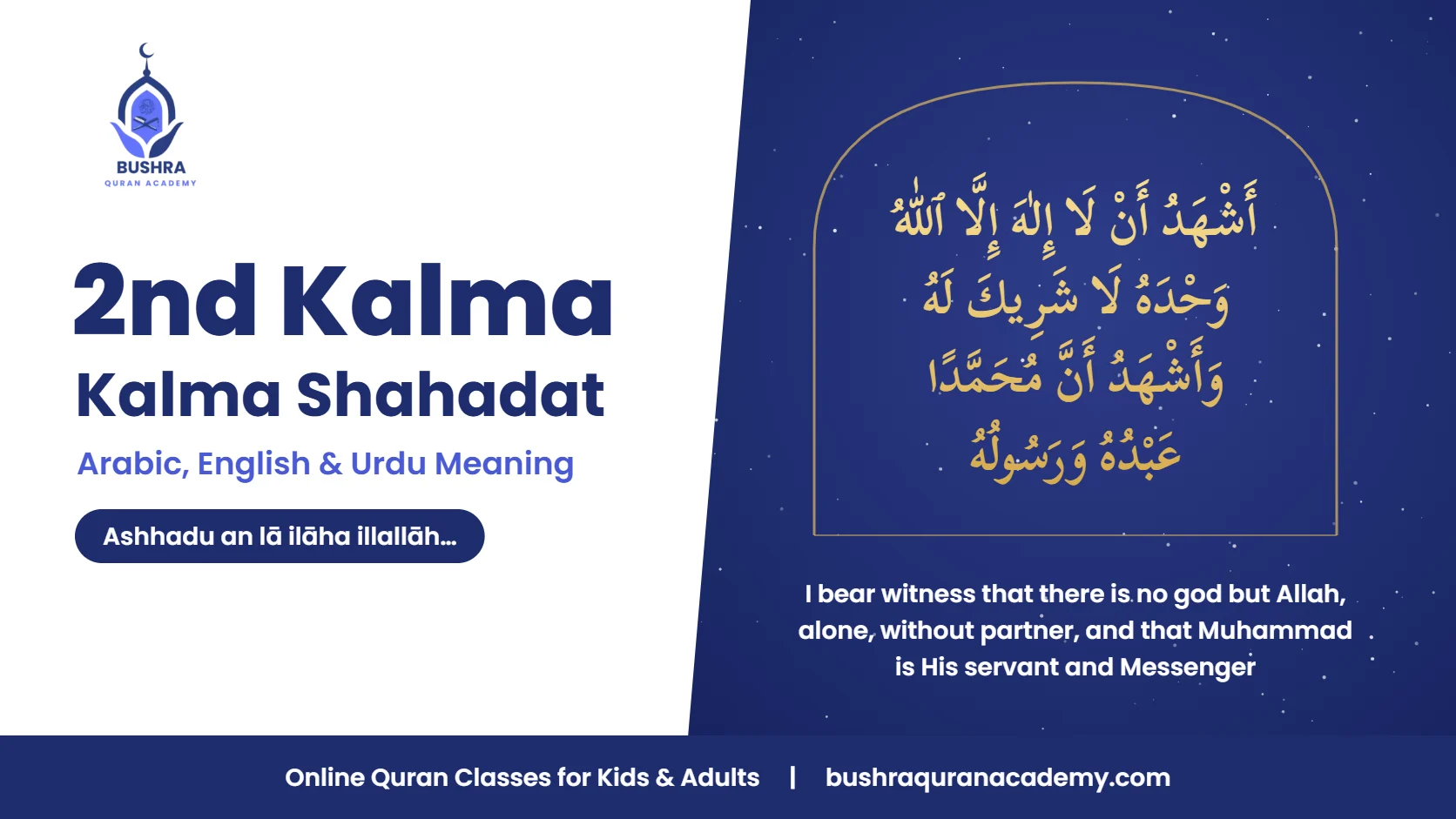
The 2nd Kalma, also called Kalma Shahadat (“the word of testimony”), is أَشْهَدُ أَنْ لَا إِلٰهَ إِلَّا ٱللّٰهُ وَحْدَهُ لَا شَرِيكَ لَهُ وَأَشْهَدُ أَنَّ مُحَمَّدًا عَبْدُهُ وَرَسُولُهُ, Ashhadu an lā ilāha illallāhu waḥdahū lā sharīka lah, wa ashhadu anna Muḥammadan ʿabduhū wa rasūluh. It means “I bear witness that there is no god but Allah, He is One and has no partner, and I bear witness that Muhammad is His servant and His Messenger.”
Its exact words come from an authentic hadith: the Prophet ﷺ taught them as the words to say after wudu, and promised that the eight gates of Paradise are opened for the one who says them (Sahih Muslim 234b). Below you will find the 2nd Kalma in Arabic, English, Urdu and Hindi, a word-by-word meaning, the hadith and Quran verses behind it, pronunciation tips and how to teach it to children. If you are new to the Kalimas, start with the 1st Kalma or see all 6 Kalimas.
Table of Contents
2nd Kalma at a Glance
| Name | 2nd Kalma, Kalma Shahadat (Kalimat ash-Shahādah, “the word of testimony”), Dusra Kalma |
|---|---|
| Arabic | أَشْهَدُ أَنْ لَا إِلٰهَ إِلَّا ٱللّٰهُ وَحْدَهُ لَا شَرِيكَ لَهُ وَأَشْهَدُ أَنَّ مُحَمَّدًا عَبْدُهُ وَرَسُولُهُ |
| Transliteration | Ashhadu an lā ilāha illallāhu waḥdahū lā sharīka lah, wa ashhadu anna Muḥammadan ʿabduhū wa rasūluh |
| English meaning | I bear witness that there is no god but Allah, He is One and has no partner, and I bear witness that Muhammad is His servant and His Messenger. |
| Number of Arabic words | 15 (as written) |
| Main message | Testifying to Tawhid (Allah alone, with no partner) and that Muhammad ﷺ is Allah’s servant and Messenger |
| Source of the wording | Sahih Muslim 234b and Sunan Abi Dawud 169 (said after wudu) |
2nd Kalma in Arabic, English, Urdu and Hindi
| Language | 2nd Kalma |
|---|---|
| Arabic | أَشْهَدُ أَنْ لَا إِلٰهَ إِلَّا ٱللّٰهُ وَحْدَهُ لَا شَرِيكَ لَهُ وَأَشْهَدُ أَنَّ مُحَمَّدًا عَبْدُهُ وَرَسُولُهُ |
| Transliteration | Ashhadu an lā ilāha illallāhu waḥdahū lā sharīka lah, wa ashhadu anna Muḥammadan ʿabduhū wa rasūluh |
| English | I bear witness that there is no god but Allah, He is One and has no partner, and I bear witness that Muhammad is His servant and His Messenger. |
| Urdu | میں گواہی دیتا ہوں کہ اللہ کے سوا کوئی معبود نہیں، وہ اکیلا ہے، اس کا کوئی شریک نہیں، اور میں گواہی دیتا ہوں کہ محمد ﷺ اس کے بندے اور اس کے رسول ہیں۔ |
| Hindi | अशहदु अल्ला इलाहा इल्लल्लाहु वहदहू ला शरीका लहू, व अशहदु अन्ना मुहम्मदन अब्दुहू व रसूलुहू: मैं गवाही देता हूँ कि अल्लाह के सिवा कोई इबादत के लायक़ नहीं, वह अकेला है, उसका कोई शरीक नहीं, और मैं गवाही देता हूँ कि मुहम्मद ﷺ उसके बंदे और उसके रसूल हैं। |
Word-by-Word Meaning of the 2nd Kalma
| Arabic | Transliteration | Meaning |
|---|---|---|
| أَشْهَدُ | Ashhadu | I bear witness, I testify |
| أَنْ | an | that |
| لَا | lā | there is no |
| إِلٰهَ | ilāha | god (anything worshipped) |
| إِلَّا | illā | except |
| ٱللّٰهُ | Allāh | Allah |
| وَحْدَهُ | waḥdahū | alone, He is One |
| لَا شَرِيكَ لَهُ | lā sharīka lah | He has no partner |
| وَأَشْهَدُ | wa ashhadu | and I bear witness |
| أَنَّ | anna | that |
| مُحَمَّدًا | Muḥammadan | Muhammad ﷺ |
| عَبْدُهُ | ʿabduhū | His servant |
| وَرَسُولُهُ | wa rasūluh | and His Messenger |
What Does the 2nd Kalma Mean?
The 2nd Kalma is a testimony, not only a statement. Saying “Ashhadu” (I bear witness) means you declare, as a witness would, something you know and accept in your heart.
- Ashhadu an lā ilāha illallāh: nothing deserves worship except Allah. Allah Himself bears witness to this: “Allah witnesses that there is no deity except Him, and [so do] the angels and those of knowledge” (Al Imran 3:18).
- Waḥdahū lā sharīka lah: He is One and has no partner in His lordship, His worship or His names and attributes: “No partner has He” (Al-An’am 6:163).
- Wa ashhadu anna Muḥammadan ʿabduhū wa rasūluh: Muhammad ﷺ is Allah’s servant, so he is not worshipped, and Allah’s Messenger, so he is obeyed and followed.
Where Do the Words of the 2nd Kalma Come From?
The numbered list of “six Kalimas” is a teaching tradition, mainly in South Asia, used to help children memorise key phrases. The words of the 2nd Kalma, however, are taught by the Prophet ﷺ himself:
- After wudu: “Whoever performs wudu and says: Ashhadu an lā ilāha illallāhu waḥdahū lā sharīka lahū wa ashhadu anna Muḥammadan ʿabduhū wa rasūluh” (Sahih Muslim 234b; also Sunan Abi Dawud 169, graded sahih by al-Albani).
- In every prayer: the tashahhud ends with “Ashhadu an lā ilāha illallāh, wa ashhadu anna Muḥammadan ʿabduhū wa rasūluh” (Sahih al-Bukhari 831).
Its meaning is also in the Quran: “So know that there is no deity except Allah” (Muhammad 47:19), “Muhammad is the Messenger of Allah” (Al-Fath 48:29), and Allah calls the Prophet ﷺ “His servant” (Al-Isra 17:1).
Why Is It Called Kalma Shahadat?
Shahādah means testimony or bearing witness. A witness speaks about what he is sure of, so the testimony must come from the heart, not the tongue alone. The Quran shows the difference: the hypocrites said “We testify that you are the Messenger of Allah”, yet Allah said He “testifies that the hypocrites are liars” (Al-Munafiqun 63:1). The words are the same; sincerity is what makes them true.
Virtues of the 2nd Kalma in Authentic Hadith
- The eight gates of Paradise: whoever performs wudu well and then says these words, “the eight gates of Paradise are opened for him and he may enter by whichever he wishes” (Sahih Muslim 234; Abu Dawud 169).
- Entry into Paradise: “If anyone testifies that none has the right to be worshipped but Allah alone, who has no partners, and that Muhammad is His slave and His Messenger… Allah will admit him into Paradise with the deeds which he had done, even if those deeds were few” (Sahih al-Bukhari 3435).
- Protection from the Fire: “There is none who testifies sincerely that none has the right to be worshipped but Allah and that Muhammad is His Messenger, except that Allah will save him from the Hell-fire” (Sahih al-Bukhari 128; see also Sahih Muslim 29).
Scholars explain that these promises belong to the one who says the words sincerely and lives by them; see the conditions of Lā ilāha illallāh.
Why "His Servant and His Messenger"?
These two words keep the believer balanced. The Prophet ﷺ said: “Do not exaggerate in praising me as the Christians praised the son of Mary, for I am only a slave. So call me the Slave of Allah and His Messenger” (Sahih al-Bukhari 3445). The Quran also teaches: “Say, I am only a man like you, to whom has been revealed that your god is one God” (Al-Kahf 18:110).
- ʿAbduhū (His servant): he is human and is not worshipped.
- Rasūluh (His Messenger): his message is from Allah, so we believe him, obey him and follow his Sunnah.
2nd Kalma vs 1st Kalma
| 1st Kalma (Tayyab) | 2nd Kalma (Shahadat) | |
|---|---|---|
| Words | لَا إِلٰهَ إِلَّا ٱللّٰهُ مُحَمَّدٌ رَسُولُ ٱللّٰهِ | أَشْهَدُ أَنْ لَا إِلٰهَ إِلَّا ٱللّٰهُ وَحْدَهُ لَا شَرِيكَ لَهُ وَأَشْهَدُ أَنَّ مُحَمَّدًا عَبْدُهُ وَرَسُولُهُ |
| Form | A statement of belief | A testimony (“I bear witness”) |
| Adds | — | “He is One and has no partner” and “His servant” |
| Said | As dhikr, any time | After wudu, in the tashahhud of every prayer, and as dhikr |
Both carry the same belief. The 2nd Kalma is the fuller form, with the words “I bear witness” and the clear denial of any partner with Allah.
How to Pronounce the 2nd Kalma Correctly
- Ashhadu: say “ash-ha-du”, with the sh and the h as two separate sounds, not “ashadu”.
- an lā: the noon merges into the lām, so it sounds “al-lā” (idghām without ghunnah).
- waḥdahū and Muḥammadan: the ح is a deep, breathy “h” from the middle of the throat, different from the light ه.
- lā sharīka: stretch the long “ī” in sharīka.
- Muḥammadan: double the “m” (shaddah) and keep the “-an” ending.
- ʿabduhū: begin with the ʿayn from the throat, then a clear stop on the “b” and “d”.
Pronunciation is learnt best by listening and repeating with a teacher. Our Tajweed course and Noorani Qaida classes cover these letters from the first lessons.
How to Teach the 2nd Kalma to Children
- Teach it in four short parts: “Ashhadu an lā ilāha illallāh”, then “waḥdahū lā sharīka lah”, then “wa ashhadu anna Muḥammadan”, then “ʿabduhū wa rasūluh”.
- Explain one idea per part: only Allah is worshipped; He has no partner; Muhammad ﷺ is His servant; and His Messenger.
- Link it to wudu: let the child say it every time after wudu, as the Sunnah teaches. The habit fixes the words.
- Point it out in salah: show the child that the same testimony comes in the tashahhud.
- Check pronunciation of ح and ع, which many children in the UK, USA and Canada find hard at first.
When Do Muslims Say the 2nd Kalma?
- After wudu: the Sunnah words exactly (Sahih Muslim 234b).
- In every prayer: in the tashahhud (Sahih al-Bukhari 831).
- In the adhan and iqamah: “Ashhadu an lā ilāha illallāh… Ashhadu anna Muḥammadan Rasūlullāh” (Sunan Abi Dawud 499, graded hasan sahih by al-Albani).
- When accepting Islam: a person enters Islam by sincerely bearing witness to both parts of this testimony.
- As dhikr: renewing one’s faith during the day.
Start Online Quran Classes with a Dedicated Teacher
Personalized online Quran learning for children and adults. Choose your course below and message our team directly to arrange a free trial class.
What would you like to learn?
Select a course and send us a message directly.
Frequently Asked Questions About the 2nd Kalma
What is the 2nd Kalma?
The 2nd Kalma (Kalma Shahadat) is "Ashhadu an lā ilāha illallāhu waḥdahū lā sharīka lah, wa ashhadu anna Muḥammadan ʿabduhū wa rasūluh". It is the testimony of faith: that there is no god but Allah, who has no partner, and that Muhammad ﷺ is His servant and Messenger.
What is the meaning of the 2nd Kalma in English?
I bear witness that there is no god but Allah, He is One and has no partner, and I bear witness that Muhammad is His servant and His Messenger.
Is the 2nd Kalma in the Quran or Hadith?
Its exact words are in authentic hadith: the Prophet ﷺ taught them as the words to say after wudu (Sahih Muslim 234b; Sunan Abi Dawud 169). Its meaning is in the Quran, for example 3:18, 47:19 and 48:29.
What is the difference between the 1st and 2nd Kalma?
The 1st Kalma is a statement of belief ("There is no god but Allah, Muhammad is the Messenger of Allah"). The 2nd Kalma is a testimony ("I bear witness…") and adds that Allah has no partner and that Muhammad ﷺ is His servant as well as His Messenger.
When should the 2nd Kalma be recited?
It is Sunnah to say it after completing wudu; the Prophet ﷺ said the eight gates of Paradise are opened for the one who says it (Sahih Muslim 234b). The same testimony is said in the tashahhud of every prayer.
Is the 2nd Kalma the same as the Shahadah?
Yes, it is a fuller form of the Shahadah. The short form commonly said when accepting Islam is "Ashhadu an lā ilāha illallāh, wa ashhadu anna Muḥammadan Rasūlullāh". Both bear witness to the same two truths.
How do you pronounce "Ashhadu an lā ilāha"?
Say "ash-ha-du al-lā i-lā-ha": the sh and h are separate sounds, and the noon of "an" merges into the lām of "lā".
Ready to Learn the Quran with Personal Guidance?
Whether you are starting from the basics, improving your Tajweed, or planning to memorize the Quran, choose the learning path that best matches your goals.
Not Sure Which Course Is Right for You?
Tell us the student's age and current Quran reading level. Our team will help you choose the right course and arrange a suitable one-to-one trial class.
Get Course Advice & Free Trial →Register Now For Online Quran
Courses
Contact us for any questions or queries, and fill out the form below to request a free trial.
We are available 24/7 for support and services
