

Reclaiming the Night: The Complete Guide to the Prayer Tahajjud
The world is loudest when we are trying to find peace. For many of us, the daylight hours are a chaotic blur of deadlines, family responsibilities, and digital noise. However, there is a hidden gateway to tranquility that opens when the rest of the world sleeps. This is the realm of the prayer tahajjud, a voluntary act of worship that carries the potential to fundamentally reshape your internal landscape.
At Bushra Quran Academy, we often see students who feel a “spiritual plateau.” They perform their five daily prayers, yet they crave something deeper—a private conversation with the Divine. That is exactly what this night prayer offers. In this guide, I will walk you through the nuances of this practice, drawing from both classical scholarship and years of personal practice to help you navigate the challenges of waking up when your bed feels most inviting.
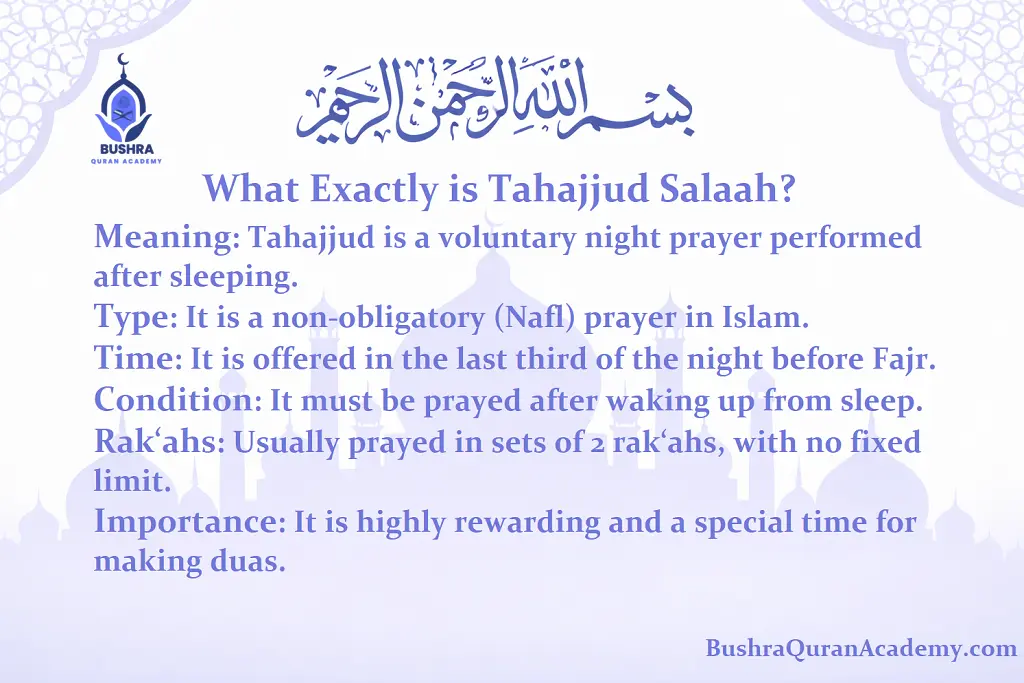
What Exactly is Tahajjud Salaah?
Before we dive into the “how,” we must understand the “what.” The term Tahajjud stems from the Arabic root h-j-d, which refers to the act of waking up from sleep. This linguistic detail is crucial. While many people use the terms Qiyam-ul-Layl (standing in the night) and Tahajjud interchangeably, there is a technical distinction that experts recognize.
Tahajjud salaah specifically refers to the prayer performed after one has slept, even if for a short duration. It is the act of intentionally breaking your rest to stand before your Creator. This sacrifice of comfort is what gives the prayer its unique status and weight.
In my own journey, I found that the psychological shift of waking up specifically for this purpose creates a level of focus that is rarely achieved during the midday bustle. You aren’t just fitting a prayer into your day; you are carving a day out of your night for the prayer.
The Ideal Tahajjud Prayer Time
One of the most frequent questions I receive at Bushra Quran Academy is: “When is the best time to pray?”
Technically, you can perform the tahajjud prayer anytime between the Isha prayer and the start of Fajr (dawn). However, the most virtuous time is the final third of the night.
Calculating the Last Third
To find this “Golden Hour,” follow this simple formula:
Count the total number of hours between Maghrib (sunset) and Fajr (dawn).
Divide that number by three.
The final segment before Fajr is the most blessed time.
How to Pray Tahajjud: A Step-by-Step Methodology
If you can perform the five daily prayers, you already possess the technical skills for the tahajjud prayer. However, the etiquette and intention differ slightly.
1. The Power of Intention (Niyyah)
Your prayer begins before you even close your eyes for sleep. Make a conscious intention that you are sleeping with the goal of waking up for the prayer tahajjud. Scholars mention that if you make this sincere intention and accidentally oversleep, the Rewarder of Actions may still grant you the merit of the prayer.
2. The Act of Waking and Wudu
When you wake, wipe the sleep from your face and remember the Divine. Perform a thorough and mindful Wudu (ablution). In my experience, using slightly cool water helps snap the nervous system out of “sleep mode,” making your focus sharper for the standing.
3. The Opening Rakats
It is recommended to start your Prayer Tahajjud with two short, light Rakats. This acts as a “spiritual warm-up.”
4. The Main Body of the Prayer
How many rakats is tahajjud? This is where the flexibility of the practice shines.
The Minimum: 2 Rakats.
The Prophetic Standard: 8 Rakats (performed in sets of two).
The Maximum: There is no strict upper limit, though balance is encouraged to avoid burnout.
Each set of two Rakats is concluded with the Tasleem (the greeting of peace to the right and left).
5. Incorporating Witr
If you have not already prayed the Witr prayer after Isha, you should conclude your night vigils with it. The Witr (an odd-numbered prayer) acts as the “seal” for your night’s worship.
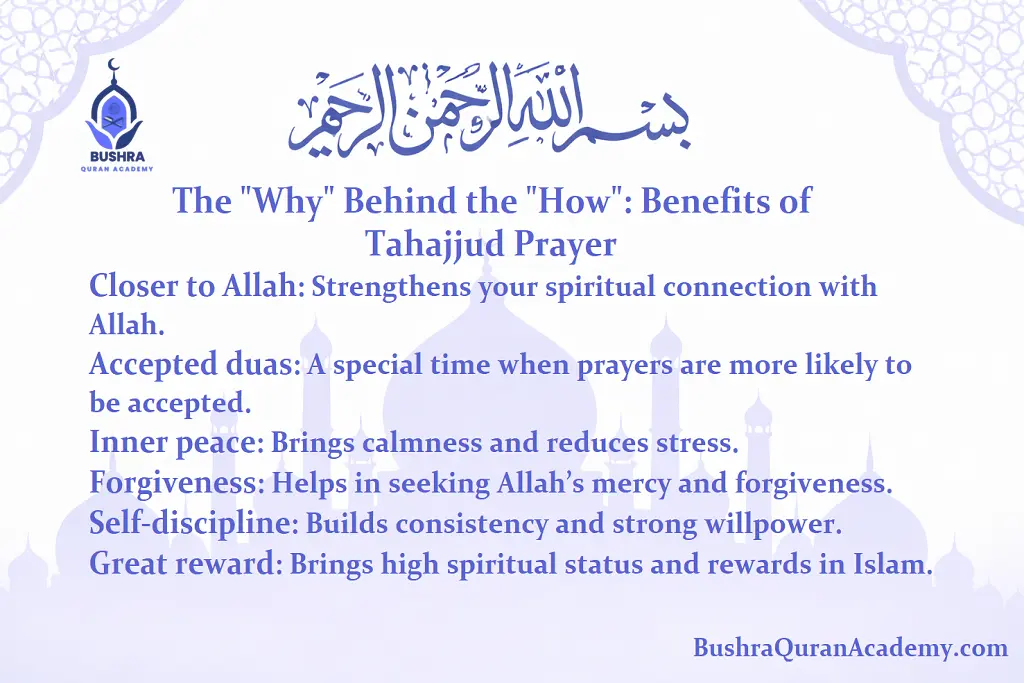
The "Why" Behind the "How": Benefits of Tahajjud Prayer
We live in a results-oriented world. While the primary goal of any worship is the pleasure of the Creator, the Benefits of Prayer Tahajjud extend into our mental and physical well-being.
Mental Clarity and Stress Reduction
In 2024 and 2025, several studies on “pre-dawn mindfulness” suggested that individuals who engage in focused meditation or prayer during the early morning hours show lower levels of cortisol (the stress hormone) throughout the day. The silence of the night allows for a “brain dump” where you can lay your anxieties down in prostration.
Discipline and Willpower
Waking up when your body screams for more sleep is the ultimate exercise in discipline. This “muscle memory” of self-control carries over into your professional life. If you can conquer your blanket, you can conquer a difficult project at work or a challenging conversation with a peer.
Deep Connection
There is an intimacy in the tahajjud salaah that is hard to replicate. You are not performing for anyone. No one sees you. It is the ultimate antidote to hypocrisy and a pure cultivation of sincerity.
Expert Tip: Don’t try to go from zero to eight Rakats overnight. Start with two Rakats just fifteen minutes before Fajr starts. Consistency beats intensity every time.
Nuanced Insights for the Dedicated Practitioner
For those who have already established a basic routine, let’s look at the deeper aspects that Bushra Quran Academy emphasizes for advanced growth.
Prolonging the Prostration (Sajdah)
The Prophet (peace be upon him) taught that the servant is closest to their Lord while in prostration. During the prayer tahajjud, there is no rush. Use this time to remain in Sajdah for longer periods. Speak from your heart. This is the time for “Munajat”—whispered intimate conversations.
Varying Your Recitation
If you have memorized different portions of the Quran, the night prayer is the best time to review them. The quiet environment allows you to reflect on the meanings of the verses. If you haven’t memorized much, even repeating small chapters with deep reflection is highly effective.
The Role of Forgiveness (Istighfar)
The Quran specifically praises those who seek forgiveness in the pre-dawn hours. Dedicate the last few minutes of your Prayer Tahajjud time—even after finishing the formal prayer—to sit and repeat Astaghfirullah (I seek forgiveness from God). It cleanses the heart for the day ahead.
Common Misconceptions About Tahajjud
To ensure this guide remains a trustworthy resource, we must address certain limitations and myths.
“It’s only for the ‘super-religious’:” This is false. The prayer tahajjud is for the broken, the stressed, and the struggling. It is a hospital for the soul, not a trophy for the perfect.
“You must stay awake until Fajr:” While staying awake to pray Fajr is excellent, it isn’t a requirement. You can pray your Rakats and go back to sleep if you have a long day ahead.
“You can’t pray it without sleeping first:” While the technical definition of Tahajjud involves waking up, if you happen to stay awake all night (perhaps due to work or study), you can still perform voluntary prayers (Qiyam), though you miss the specific reward of “breaking” your sleep.
Final Thoughts from Bushra Quran Academy
The journey toward a consistent prayer tahajjud is not a sprint; it is a lifelong walk. There will be nights when you feel “on fire” with spiritual energy, and nights when you can barely keep your eyes open. Both are part of the process.
At Bushra Quran Academy, we believe that the goal of the tahajjud salaah is to build a bridge between your heart and the Divine. When the world is dark and silent, that bridge becomes much easier to cross.
If you are looking to deepen your understanding of the Quran to enhance your night prayers, or if you simply want to learn how to recite with the beauty this prayer deserves, we invite you to join our community. The night is waiting for you. Don’t let it pass by in silence.
Start tonight. Set your alarm ten minutes earlier than usual. Make your Wudu. Stand on your mat. And just talk. You’ll be surprised at how much the Creator has been waiting to listen.
Frequently Asked Questions About Prayer Tahajjud
How many rakats is tahajjud exactly?
Can I pray tahajjud 10 minutes before Fajr?
What is the difference between Tahajjud and Qiyam-ul-Layl?
Do I have to recite long Surahs?
More To Explore

12 Rabi ul Awal 2026: When Is 12 Rabi ul Awal 2026?
When is 12 Rabi ul Awal 2026? Pakistan will observe 12 Rabi ul Awal 1448 AH on Wednesday, 26 August 2026, following its official moon-sighting decision. Other countries and Islamic calendars may observe it on 25 or 26 August depending on their calendar method.

Best Muslim Baby Boy Names 2026: Quranic, Modern & Meaningful
Discover beautiful Muslim baby boy names for 2026, including Quranic, modern, rare, Arabic, and meaningful Islamic names.

How to Help Kids Learn Quran Online Effectively
Learn simple ways to help kids learn Quran online with clear goals, a quiet study space, qualified teachers, and regular practice.

How to Choose the Best Online Quran Classes for Kids in USA
Looking for the best online Quran classes for kids in USA? Discover qualified teachers, Tajweed programs, flexible schedules, and free trial lessons.
When is Qurbani 2026? Exact Dates & Sacrifice Rules
Tracking moon sightings across multiple time zones disrupts your sacred preparation. This definitive guide delivers precise dates, compliance checklists, and livestock metrics for Qurbani 2026.

Confirmed Eid ul Adha 2026 Date: Exact Global Calendars.
Our verified global tracking calendar presents the confirmed schedule for eid ul adha 2026. Prepare your local family rituals accurately now.
Register Now For Online Quran
Courses
Contact us for any questions or queries, and fill out the form below to request a free trial.
We are available 24/7 for support and services
