
Bismillah Meaning in English and Arabic: Word by Word Guide
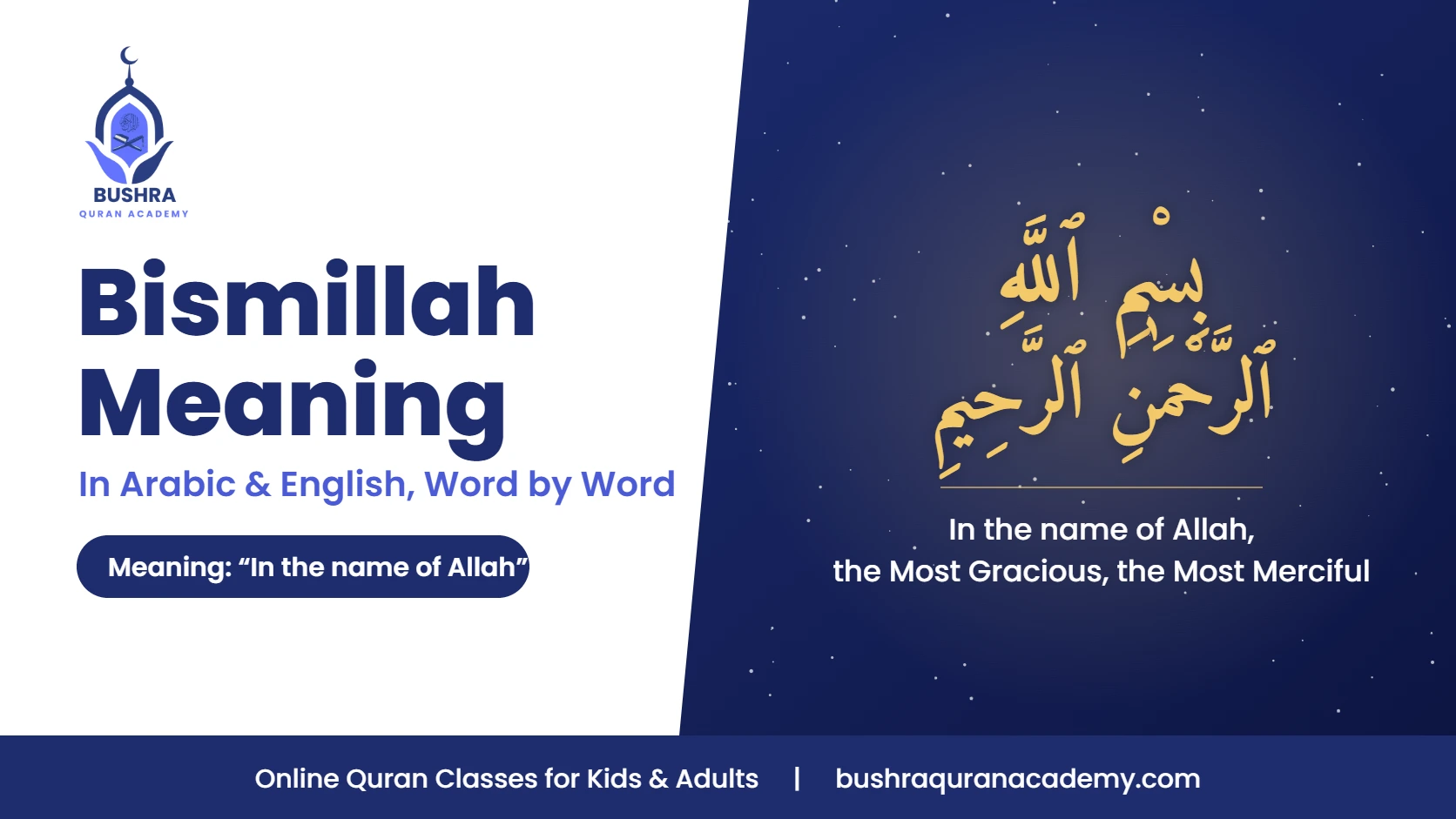
Bismillah (بِسْمِ ٱللَّٰهِ) means “In the name of Allah.” Its full form, Bismillahir Rahmanir Rahim (بِسْمِ ٱللَّٰهِ ٱلرَّحْمَٰنِ ٱلرَّحِيمِ), means “In the name of Allah, the Most Gracious, the Most Merciful.”
Muslims say Bismillah before reading the Quran, before eating and drinking, and at the start of many daily actions. This guide explains the Bismillah meaning in Arabic and English word by word, where it appears in the Quran, and when the Sunnah teaches us to say it.
Table of Contents
Bismillah Meaning: The Quick Answer
Bismillah is an Arabic phrase that means “In the name of Allah.” The longer form, known as the Basmala, adds two of Allah’s names, Ar-Rahman and Ar-Rahim, which both come from the Arabic root for mercy (r-h-m). It opens 113 of the 114 surahs of the Quran.
Bismillah in Arabic, Transliteration and English
| Form | Arabic | Transliteration | English meaning |
|---|---|---|---|
| Short | بِسْمِ ٱللَّٰهِ | Bismillah | In the name of Allah |
| Full (Basmala) | بِسْمِ ٱللَّٰهِ ٱلرَّحْمَٰنِ ٱلرَّحِيمِ | Bismillahir Rahmanir Rahim | In the name of Allah, the Most Gracious, the Most Merciful |
| When slaughtering an animal | بِسْمِ ٱللَّٰهِ وَٱللَّٰهُ أَكْبَرُ | Bismillahi wallahu akbar | In the name of Allah, and Allah is the Greatest |
Word-by-Word Bismillah Meaning
- Bi (بِ): “in” or “with”.
- Ism (ٱسْم): “name”. Joined with bi, it is read bismi, “in the name of”.
- Allah (ٱللَّٰه): the proper name of the One God, the Creator.
- Ar-Rahman (ٱلرَّحْمَٰن): “the Most Gracious” or “the Entirely Merciful”, His mercy that reaches all of creation.
- Ar-Rahim (ٱلرَّحِيم): “the Most Merciful” or “the Especially Merciful”. Scholars such as Ibn Kathir explain it as His special mercy for the believers, as in the verse “And He is ever Merciful to the believers” (Quran 33:43).
Where Does Bismillah Appear in the Quran?
- It begins 113 of the 114 surahs. Surah At-Tawbah (Surah 9) is the only surah that does not begin with Bismillah.
- It also appears inside Surah An-Naml (27:30), in the letter of Prophet Sulaiman (Solomon), peace be upon him, to the Queen of Sheba: “Indeed, it is from Sulaiman, and indeed, it reads: In the name of Allah, the Most Gracious, the Most Merciful.”
- Counting both, the full Bismillah appears 114 times in the Quran.
Scholars differ on whether Bismillah is a verse of Surah Al-Fatiha. The Shafi’i school counts it as the first verse of Al-Fatiha, while the Hanafi and Maliki schools do not count it as part of the surah. All agree that it is part of the Quran in Surah An-Naml.
When Should a Muslim Say Bismillah?
Before Eating and Drinking
The Prophet ﷺ taught a young boy: “Mention the name of Allah, eat with your right hand, and eat from what is in front of you.” (Sahih al-Bukhari 5376, Sahih Muslim 2022). If you forget at the start of a meal, say when you remember: Bismillahi awwalahu wa akhirahu (In the name of Allah at its beginning and its end) (Sunan Abi Dawud 3767, Jami’ at-Tirmidhi 1858).
Before Reading the Quran
Before reciting, a Muslim first seeks refuge in Allah with the Tauz, as Allah says: “So when you recite the Quran, seek refuge in Allah from Shaytan, the accursed” (Quran 16:98). Bismillah is then recited at the start of every surah except Surah At-Tawbah.
Before Wudu
The Prophet ﷺ said: “There is no wudu for the one who does not mention the name of Allah over it.” (Sunan Abi Dawud 101). Scholars differ on the strength of this hadith. Most hold that saying Bismillah before wudu is recommended (Sunnah), and some consider it obligatory.
When Leaving the House
The Prophet ﷺ taught that whoever says when leaving home, Bismillah, tawakkaltu ‘alallah, wa la hawla wa la quwwata illa billah (In the name of Allah, I put my trust in Allah, and there is no might nor power except with Allah), is told: “You are guided, sufficed and protected.” (Sunan Abi Dawud 5095, Jami’ at-Tirmidhi 3426).
Before Entering the Toilet
Saying Bismillah before entering the toilet acts as a screen between the jinn and a person’s private parts (Jami’ at-Tirmidhi 606). It is followed by the dua Allahumma inni a’udhu bika minal khubuthi wal khaba’ith (O Allah, I seek refuge in You from the male and female evil ones) (Sahih al-Bukhari 142).
Before Sleeping
Before sleeping, the Prophet ﷺ would say: Bismika Allahumma amutu wa ahya (In Your name, O Allah, I die and I live) (Sahih al-Bukhari 6324).
When Slaughtering an Animal
Allah says: “So eat of that over which the name of Allah has been mentioned” (Quran 6:118). When the Prophet ﷺ sacrificed two rams, he said Bismillahi wallahu akbar (Sahih Muslim 1966).
Bismillah or the Full Bismillah: Which Should You Say?
For daily actions such as eating, drinking or leaving home, the short Bismillah is what the hadith mention, and it is enough. The full Bismillahir Rahmanir Rahim is recited at the start of surahs and is commonly used to begin letters, books and lessons, following the letter of Prophet Sulaiman (27:30) and the letters the Prophet ﷺ sent to rulers, such as his letter to Heraclius (Sahih al-Bukhari 7). When slaughtering, the words are “Bismillahi wallahu akbar”, without Ar-Rahman and Ar-Rahim.
The Virtues of Saying Bismillah
- It keeps Shaytan away from your food. The Prophet ﷺ said that Shaytan considers food lawful for himself when the name of Allah is not mentioned over it (Sahih Muslim 2017).
- It protects your home. When a person mentions Allah on entering the home and before eating, Shaytan says to his companions: “You have no place to stay and no dinner.” (Sahih Muslim 2018).
- It reminds us that we depend on Allah. Starting with His name means asking for His help and blessing in what we do.
A note on a famous saying: the narration “Every important matter that does not begin with Bismillah is cut off” is widely quoted, but many hadith scholars graded its chains as weak. The authentic hadith above are enough to show the value of saying Bismillah.
What Does 786 Mean?
In parts of South Asia, people sometimes write the number 786 in place of Bismillah. It comes from adding up the abjad (letter-number) values of the letters of Bismillahir Rahmanir Rahim. This custom is not from the Quran or the Sunnah, and many scholars advise writing or saying the words of Bismillah themselves.
Learn to Recite Bismillah with Correct Tajweed
Bismillah has some simple Tajweed points. The lam in the name Allah is pronounced light here because it comes after a kasra (bismi-llah), and the lam of “al” in Ar-Rahman and Ar-Rahim is silent because ra is a sun letter.
To learn these rules with a teacher, see our Tajweed e Quran course, or start from the basics with Noorani Qaida. You may also like: Surah Al-Fatiha meaning and benefits.
Start Online Quran Classes with a Dedicated Teacher
Personalized online Quran learning for children and adults. Choose your course below and message our team directly to arrange a free trial class.
What would you like to learn?
Select a course and send us a message directly.
Frequently Asked Questions About Bismillah
What is the meaning of Bismillah?
Bismillah means "In the name of Allah." The full form, Bismillahir Rahmanir Rahim, means "In the name of Allah, the Most Gracious, the Most Merciful."
Which surah does not start with Bismillah?
Surah At-Tawbah (Surah 9) is the only surah of the Quran that does not begin with Bismillah.
How many times is Bismillah in the Quran?
The full Bismillah appears 114 times: at the start of 113 surahs and once inside Surah An-Naml (27:30).
What should I say if I forget Bismillah before eating?
Say "Bismillahi awwalahu wa akhirahu" (In the name of Allah at its beginning and its end) as soon as you remember (Sunan Abi Dawud 3767, Jami' at-Tirmidhi 1858).
Is Bismillah part of Surah Al-Fatiha?
Scholars differ. The Shafi'i school counts it as the first verse of Al-Fatiha, while the Hanafi and Maliki schools do not.
What is the difference between Ar-Rahman and Ar-Rahim?
Both names come from the Arabic root for mercy. Ar-Rahman refers to Allah's mercy that reaches all of creation, and Ar-Rahim is often explained as His special mercy for the believers.
Ready to Learn the Quran with Personal Guidance?
Whether you are starting from the basics, improving your Tajweed, or planning to memorize the Quran, choose the learning path that best matches your goals.
Not Sure Which Course Is Right for You?
Tell us the student's age and current Quran reading level. Our team will help you choose the right course and arrange a suitable one-to-one trial class.
Get Course Advice & Free Trial →Register Now For Online Quran
Courses
Contact us for any questions or queries, and fill out the form below to request a free trial.
We are available 24/7 for support and services
