

Darood Ibrahim (Durood e Ibrahimi): Arabic, English and Urdu Meaning
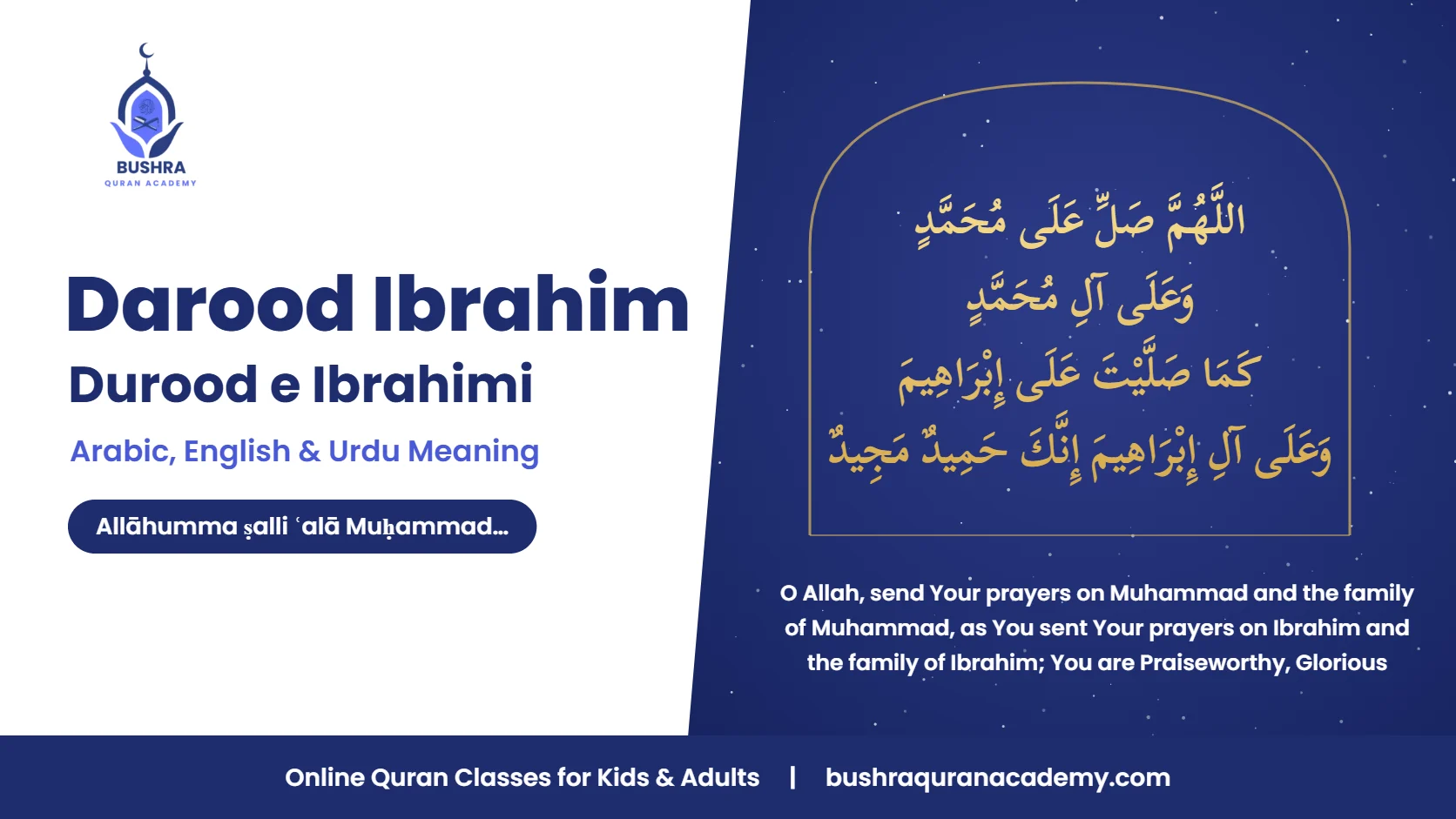
Darood Ibrahim (Durood e Ibrahimi, also called aṣ-Ṣalāt al-Ibrāhīmiyyah) is the salawat the Prophet ﷺ himself taught his Companions when they asked how to send blessings on him. Muslims recite it in the final sitting of every prayer. In Arabic it is:
اللَّهُمَّ صَلِّ عَلَى مُحَمَّدٍ، وَعَلَى آلِ مُحَمَّدٍ، كَمَا صَلَّيْتَ عَلَى إِبْرَاهِيمَ وَعَلَى آلِ إِبْرَاهِيمَ، إِنَّكَ حَمِيدٌ مَجِيدٌ، اللَّهُمَّ بَارِكْ عَلَى مُحَمَّدٍ، وَعَلَى آلِ مُحَمَّدٍ، كَمَا بَارَكْتَ عَلَى إِبْرَاهِيمَ، وَعَلَى آلِ إِبْرَاهِيمَ، إِنَّكَ حَمِيدٌ مَجِيدٌ
Allāhumma ṣalli ʿalā Muḥammadin wa ʿalā āli Muḥammad, kamā ṣallayta ʿalā Ibrāhīma wa ʿalā āli Ibrāhīm, innaka Ḥamīdun Majīd. Allāhumma bārik ʿalā Muḥammadin wa ʿalā āli Muḥammad, kamā bārakta ʿalā Ibrāhīma wa ʿalā āli Ibrāhīm, innaka Ḥamīdun Majīd.
Meaning: “O Allah, send Your prayers on Muhammad and on the family of Muhammad, as You sent Your prayers on Ibrahim and on the family of Ibrahim; You are Praiseworthy, Glorious. O Allah, send Your blessings on Muhammad and on the family of Muhammad, as You blessed Ibrahim and the family of Ibrahim; You are Praiseworthy, Glorious.” (Sahih al-Bukhari 3370)
Allah commands the believers to send blessings on the Prophet ﷺ (Al-Ahzab 33:56), and Darood Ibrahim is the answer to “how?” in his own words. This guide gives the full text in Arabic, English, Urdu and Hindi, a word-by-word meaning, the three authentic wordings found in Bukhari and Muslim, where it comes in salah and what the four schools say about it, and only the virtues that are reported in reliable hadith. Every reference links to its source on Sunnah.com or Quran.com.
Table of Contents
Darood Ibrahim at a Glance
| Names | Darood Ibrahim, Durood e Ibrahimi, Durood Ibrahimi, aṣ-Ṣalāt al-Ibrāhīmiyyah, “Darood Sharif” in namaz |
|---|---|
| Opening words | اللَّهُمَّ صَلِّ عَلَى مُحَمَّدٍ Allāhumma ṣalli ʿalā Muḥammad |
| Taught by | The Prophet ﷺ, when the Companions asked how to send salawat (Sahih al-Bukhari 3370) |
| Command in the Quran | “O you who have believed, ask [Allah to confer] blessing upon him and ask [Allah to grant him] peace” (33:56) |
| Where in salah | Final sitting, after the tashahhud and before the closing dua and salam |
| Ruling in salah | Obligatory in the final sitting for the Shafi’i and Hanbali schools; a confirmed Sunnah for the Hanafi and Maliki schools |
| Main virtue | “He who blesses me once, Allah blesses him ten times” (Sahih Muslim 408) |
Darood Ibrahim in Arabic, English, Urdu and Hindi
| Language | Darood Ibrahim |
|---|---|
| Arabic | اللَّهُمَّ صَلِّ عَلَى مُحَمَّدٍ، وَعَلَى آلِ مُحَمَّدٍ، كَمَا صَلَّيْتَ عَلَى إِبْرَاهِيمَ وَعَلَى آلِ إِبْرَاهِيمَ، إِنَّكَ حَمِيدٌ مَجِيدٌ، اللَّهُمَّ بَارِكْ عَلَى مُحَمَّدٍ، وَعَلَى آلِ مُحَمَّدٍ، كَمَا بَارَكْتَ عَلَى إِبْرَاهِيمَ، وَعَلَى آلِ إِبْرَاهِيمَ، إِنَّكَ حَمِيدٌ مَجِيدٌ |
| Transliteration | Allāhumma ṣalli ʿalā Muḥammadin wa ʿalā āli Muḥammad, kamā ṣallayta ʿalā Ibrāhīma wa ʿalā āli Ibrāhīm, innaka Ḥamīdun Majīd. Allāhumma bārik ʿalā Muḥammadin wa ʿalā āli Muḥammad, kamā bārakta ʿalā Ibrāhīma wa ʿalā āli Ibrāhīm, innaka Ḥamīdun Majīd. |
| English | O Allah, send Your prayers on Muhammad and on the family of Muhammad, as You sent Your prayers on Ibrahim and on the family of Ibrahim; You are Praiseworthy, Glorious. O Allah, send Your blessings on Muhammad and on the family of Muhammad, as You blessed Ibrahim and the family of Ibrahim; You are Praiseworthy, Glorious. |
| Urdu | اے اللہ! محمد ﷺ پر اور آلِ محمد پر رحمت نازل فرما، جیسے تو نے ابراہیم علیہ السلام پر اور آلِ ابراہیم پر رحمت نازل فرمائی، بے شک تو تعریف کے لائق اور بزرگی والا ہے۔ اے اللہ! محمد ﷺ پر اور آلِ محمد پر برکت نازل فرما، جیسے تو نے ابراہیم علیہ السلام پر اور آلِ ابراہیم پر برکت نازل فرمائی، بے شک تو تعریف کے لائق اور بزرگی والا ہے۔ |
| Hindi | अल्लाहुम्मा सल्लि अला मुहम्मदिंव व अला आलि मुहम्मद, कमा सल्लैता अला इब्राहीमा व अला आलि इब्राहीम, इन्नका हमीदुम मजीद। अल्लाहुम्मा बारिक अला मुहम्मदिंव व अला आलि मुहम्मद, कमा बारक्ता अला इब्राहीमा व अला आलि इब्राहीम, इन्नका हमीदुम मजीद। अर्थ: ऐ अल्लाह! मुहम्मद ﷺ और उनकी आल पर रहमत भेज, जैसे तूने इब्राहीम और उनकी आल पर रहमत भेजी; बेशक तू तारीफ़ के लायक़ और बुज़ुर्गी वाला है। ऐ अल्लाह! मुहम्मद ﷺ और उनकी आल पर बरकत भेज, जैसे तूने इब्राहीम और उनकी आल पर बरकत भेजी; बेशक तू तारीफ़ के लायक़ और बुज़ुर्गी वाला है। |
Word-by-Word Meaning of Darood Ibrahim
| Arabic | Transliteration | Meaning |
|---|---|---|
| اللَّهُمَّ | Allāhumma | O Allah |
| صَلِّ | ṣalli | send Your prayers (praise and mercy) |
| عَلَى مُحَمَّدٍ | ʿalā Muḥammad | upon Muhammad ﷺ |
| وَعَلَى آلِ مُحَمَّدٍ | wa ʿalā āli Muḥammad | and upon the family of Muhammad |
| كَمَا | kamā | just as |
| صَلَّيْتَ | ṣallayta | You sent prayers |
| عَلَى إِبْرَاهِيمَ | ʿalā Ibrāhīm | upon Ibrahim (Abraham) عليه السلام |
| إِنَّكَ | innaka | indeed You are |
| حَمِيدٌ | Ḥamīd | Praiseworthy |
| مَجِيدٌ | Majīd | Glorious, full of honour |
| بَارِكْ | bārik | bless (increase and make lasting) |
| بَارَكْتَ | bārakta | You blessed |
What Does Darood Ibrahim Mean?
Darood Ibrahim has two requests, each followed by the same praise of Allah:
- Ṣalli (prayers): Imam al-Bukhari reports from Abu al-ʿAliyah that Allah’s ṣalāh on the Prophet is His praise of him before the angels (Sahih al-Bukhari, chapter on Surah al-Ahzab). When we say “Allāhumma ṣalli”, we ask Allah to raise his mention and honour him.
- Bārik (blessings): barakah means increase and continuance of good. We ask Allah to increase and keep the good He gave the Prophet ﷺ and his family.
- “As You did for Ibrahim”: Ibrahim عليه السلام is the father of the prophets, and of his household the Quran says: “the mercy of Allah and His blessings be upon you, people of the house” (Hud 11:73). We ask for the same kind of honour for the Prophet ﷺ and his family.
- Ḥamīdun Majīd: the dua ends with two names of Allah: the One who is praised for everything He does, and the One full of glory and generosity.
The 3 Authentic Wordings in Bukhari and Muslim
The Prophet ﷺ taught Darood Ibrahim in slightly different words on different occasions. All of these are authentic, and you may recite any of them:
| Narrator and source | What is different |
|---|---|
| Kaʿb ibn ʿUjrah, Sahih al-Bukhari 3370 | The most common wording (the one above): “Muhammad and the family of Muhammad… Ibrahim and the family of Ibrahim”. |
| Abu Humaid as-Saʿidi, Sahih al-Bukhari 3369 | “…on Muhammad and his wives and his offspring, as You sent prayers on the family of Ibrahim…” |
| Abu Masʿud al-Ansari, Sahih Muslim 405 | Adds “fil-ʿālamīn” (among all the worlds) before “innaka Ḥamīdun Majīd”. |
The Arabic of the Abu Humaid wording: اللَّهُمَّ صَلِّ عَلَى مُحَمَّدٍ وَأَزْوَاجِهِ وَذُرِّيَّتِهِ، كَمَا صَلَّيْتَ عَلَى آلِ إِبْرَاهِيمَ، وَبَارِكْ عَلَى مُحَمَّدٍ وَأَزْوَاجِهِ وَذُرِّيَّتِهِ، كَمَا بَارَكْتَ عَلَى آلِ إِبْرَاهِيمَ، إِنَّكَ حَمِيدٌ مَجِيدٌ
Why Did the Companions Ask How to Send Salawat?
When Allah revealed: “Indeed, Allah confers blessing upon the Prophet, and His angels [ask Him to do so]. O you who have believed, ask [Allah to confer] blessing upon him and ask [Allah to grant him] peace” (Al-Ahzab 33:56), the Companions already knew how to send salam, because the tashahhud teaches “as-salāmu ʿalayka ayyuhan-Nabiyy”. So they asked: “How should we send ṣalāh on you?” Darood Ibrahim was his answer (Sahih al-Bukhari 3370). This is why scholars say no wording is better than the one he chose himself.
Virtues of Sending Darood (Authentic Hadith Only)
- Ten blessings for one: “He who blesses me once, Allah would bless him ten times” (Sahih Muslim 408).
- Sins erased and rank raised: “…Allah will send salah upon him tenfold, will erase ten sins from him, and will raise him ten degrees in status” (Sunan an-Nasa’i 1297, graded sahih).
- Closeness on the Day of Judgement: “The person closest to me on the Day of Judgement is the one who sent the most salat upon me” (Jami’ at-Tirmidhi 484, graded hasan).
- It reaches him: “Invoke blessings on me, for your blessings reach me wherever you may be” (Sunan Abi Dawud 2042, sahih).
- More on Friday: “Invoke more blessings on me that day [Friday], for your blessings will be submitted to me” (Sunan Abi Dawud 1047, sahih).
- Not being a miser: “The stingy person is the one before whom I am mentioned and he does not send salat upon me” (Jami’ at-Tirmidhi 3546, hasan sahih).
Claims of fixed rewards for reciting a darood a certain number of times (for example “1,000 times for wealth”) are not found in these collections. The virtues above are enough, and they are authentic.
Where Does Darood Ibrahim Come in Salah?
- Final sitting: after the tashahhud (“at-taḥiyyātu lillāh… wa ashhadu anna Muḥammadan ʿabduhū wa rasūluh”).
- Then Darood Ibrahim.
- Then a dua of your choice, then the salam. The Prophet ﷺ taught this order: praise Allah, send salat on the Prophet, “then let him supplicate after that, whatever he wishes” (Jami’ at-Tirmidhi 3477, graded hasan).
Is it obligatory? Scholars differ. The Shafi’i and Hanbali schools hold that sending salat on the Prophet ﷺ in the final sitting is obligatory, so the prayer is incomplete without it. The Hanafi and Maliki schools hold it is a confirmed Sunnah. All four agree it should not be left out. In the first sitting of a three- or four-rak’ah prayer, most people stop after the tashahhud; follow the practice of your school or teacher.
Darood Ibrahim vs Other Durood
| Darood | Source | Note |
|---|---|---|
| Darood Ibrahim (Durood e Ibrahimi) | Taught by the Prophet ﷺ (Bukhari 3370, 3369; Muslim 405) | The best and most complete wording; used in salah |
| Short salawat: صَلَّى اللهُ عَلَيْهِ وَسَلَّمَ | Fulfils the general command of 33:56 | Said whenever his name is mentioned |
| Darood Tanjeena, Darood Taj and similar | Later compositions, not narrated from the Prophet ﷺ in the hadith collections | Their meanings should be checked; the reported wordings are preferred |
How to Pronounce Darood Ibrahim Correctly
- ṣalli: the ص is a heavy “s” with the tongue low; do not say a light “salli” with س.
- ʿalā: begin with the ع from the middle of the throat.
- Muḥammad: the ح is a breathy throat “h”, and the “m” is doubled (shaddah).
- āli (family): a long “aa”; do not confuse it with ʿalā.
- Ibrāhīm: two long vowels, “Ib-raa-heem”.
- Ḥamīdun Majīd: stretch the “ee” in both words; the “n” of Ḥamīdun merges into the “m” of Majīd with ghunnah.
Pronunciation is best learnt by listening and repeating with a teacher, which our Tajweed course and Noorani Qaida classes do from the first lessons.
How to Teach Darood Ibrahim to Children
- Split it into two halves: the “ṣalli” half and the “bārik” half. Children notice that the second half repeats the first with one word changed.
- Teach one line a day and repeat it before bed.
- Explain one word a day: āl (family), kamā (just as), Ḥamīd, Majīd.
- Practise it in salah: once the child knows the tashahhud, add Darood Ibrahim in the final sitting.
- Build the habit of saying “ṣallallāhu ʿalayhi wa sallam” whenever the Prophet’s name is mentioned.
When to Recite Darood Ibrahim
- In every prayer: in the final sitting, after the tashahhud.
- Before your dua: praise Allah, send salawat, then ask (Tirmidhi 3477).
- On Fridays: send more salawat than usual (Abu Dawud 1047). See our Friday duas guide.
- When his name is mentioned: at least the short salawat (Tirmidhi 3546).
- Any time: there is no set number; the more, the better (Tirmidhi 484).
Start Online Quran Classes with a Dedicated Teacher
Personalized online Quran learning for children and adults. Choose your course below and message our team directly to arrange a free trial class.
What would you like to learn?
Select a course and send us a message directly.
Frequently Asked Questions About Darood Ibrahim
What is Darood Ibrahim?
Darood Ibrahim (Durood e Ibrahimi) is the salawat taught by the Prophet ﷺ: "Allāhumma ṣalli ʿalā Muḥammadin wa ʿalā āli Muḥammad, kamā ṣallayta ʿalā Ibrāhīma wa ʿalā āli Ibrāhīm, innaka Ḥamīdun Majīd…". It is recited in the final sitting of every prayer (Sahih al-Bukhari 3370).
Is Darood Ibrahim in the Quran?
The command to send blessings on the Prophet ﷺ is in the Quran (33:56). The wording of Darood Ibrahim comes from authentic hadith in Sahih al-Bukhari and Sahih Muslim.
Which version of Darood Ibrahim is correct?
All three reported wordings are correct: Bukhari 3370 (Kaʿb ibn ʿUjrah), Bukhari 3369 (Abu Humaid, "his wives and his offspring") and Muslim 405 (Abu Masʿud, adding "fil-ʿālamīn"). You may recite any of them.
Is Darood Ibrahim obligatory in namaz?
Scholars differ. The Shafi'i and Hanbali schools say it is obligatory in the final sitting; the Hanafi and Maliki schools say it is a confirmed Sunnah. All agree it should not be left out.
Can I recite Darood Ibrahim outside salah?
Yes. It can be recited at any time, especially before making dua and on Fridays. There is no fixed number.
Is Darood Tanjeena the same as Darood Ibrahim?
No. Darood Ibrahim was taught by the Prophet ﷺ himself. Darood Tanjeena is a later composition that is not narrated in the hadith collections.
What is the shortest Darood?
"Ṣallallāhu ʿalayhi wa sallam" (may Allah send blessings and peace upon him), said whenever the Prophet's name is mentioned.
Ready to Learn the Quran with Personal Guidance?
Whether you are starting from the basics, improving your Tajweed, or planning to memorize the Quran, choose the learning path that best matches your goals.
Not Sure Which Course Is Right for You?
Tell us the student's age and current Quran reading level. Our team will help you choose the right course and arrange a suitable one-to-one trial class.
Get Course Advice & Free Trial →Register Now For Online Quran
Courses
Contact us for any questions or queries, and fill out the form below to request a free trial.
We are available 24/7 for support and services
